A Historical and Biblical Framework for Examination

This site shows that words written thousands of years ago align perfectly to ancient and modern history. It presents a coherent way of understanding Revelation's meanings, historical and future events with the words of Jesus and Daniel's support. This history to scriptural alignment frequently disproves conventional religious beliefs, and other times reinforces them, by presenting biblical scripture or historical events. This website aligns the many time frames of Revelation and Daniel to historical dates, ancient and modern.

Nothing here is meant to add to or take away from the words of the Book of Revelation. Those words stand on their own. This page does not claim to be the final word on prophecy. This is simply one possible map of how they connect to history.

1. Establishing Principles for Reading Daniel and Revelation

This chapter establishes the foundational principles for interpreting the prophetic texts.

A. Why Jesus Pointed to Daniel's Abomination of Desolation as a Future Marker

"Let the reader understand."

Daniel is describing something far beyond Jerusalem. He is not speaking about the destruction of the city in 70AD, but about the final world power before Christ's return. The destruction of Jerusalem happened nearly two thousand years earlier. Jesus made Daniel central to understanding when the end is drawing near when He said, "So when you see the abomination of desolation spoken of by the prophet Daniel, standing in the holy place (let the reader understand)" (Matthew 24:15).

Both Matthew and Mark record this statement, and both include the phrase "let the reader understand." When the same instruction is repeated by two Gospel writers, it signals deliberate emphasis and great importance. We see this same pattern in Revelation in two crucial places, when the reader is told: "This calls for wisdom: let the one who has understanding calculate the number," and when explaining the seven headed Beast: "This calls for a mind with wisdom." In both cases, the language is nearly identical. These statements serve as attention flags. They are intended to emphasize the importance of careful reading. Take note of them, consider them closely, and make sure the meaning is fully understood.

Matthew and Mark record Jesus' account about the time of trouble. Luke records the same conversation, but instead of referencing Daniel's abomination of desolation, he moves directly into the destruction of Jerusalem. Yet Luke uses the same descriptive language. Both events are catastrophic and are described using the same prophetic vocabulary. Luke later returns to this same end time language again, aligning once more with Matthew and Mark, though with less detail. This establishes a dual prophecy expressed by three authors: Jerusalem's destruction immediately before the escalation that draws the rest of the kingdoms into Armageddon and Christ's return.

Daniel and Revelation complement one another in countless ways. Together, they validate the alignment of world events with Scripture.

B. The Time of Trouble

This section explores the time of trouble as a near extinction level event.

When fire and sulfur rain down into our atmosphere it will put sulfur dioxide in our water and air. Sulfur dioxide gas in the air is going to be the first problem for mankind. It's an acid and it burns the lungs and eyes and will affect people with existing breathing complications the worst. On the second day a "mountain as it were on fire" impacts the ocean, and all the ships are destroyed. This no doubt will cause a tsunami unlike anything the world has seen. Anything under a 50 foot elevation is more than likely going to feel its effects. The injection of water vapor can act as a potent greenhouse gas in the upper atmosphere, leading to long-term climate changes. The heat in the upper atmosphere from sulfur particles igniting will generate a radiant heat from day one. When a meteor strikes the ocean on the second day the upper atmosphere will be prepped for the acceptance of moisture from the meteor impact. This will cause what's known as the "Runaway Greenhouse Effect". There is a Runaway threshold for the Greenhouse Effect and this will make conditions optimal. At this point the waters turn bitter, biblically called wormwood, and many men die from the waters. The intense heat in the upper atmosphere will radiate down on Mankind and vegetation. It will be unbearable if exposed to it in the open. The aftermath of this 4-day event will kill a lot of people from starvation and lack of drinking water. A conservative estimate of over a billion lives lost is inevitable. With a world population of approximately 8.1 billion people, having 7.1 billion people left alive is reasonable. The next event is full scale nuclear war where the Bible says a third of mankind is killed. That would amount to 2.3 billion people dying, leaving 4.8 billion people remaining. With the last plague of hail and a great earthquake taken into account, this estimate is conservative. That makes this close to an extinction level event. In three and a half years the runaway greenhouse effect will have depleted the oceans significantly. As the water surface area of the oceans dwindle, the lack of moisture available will mandate an equilibrium. There will be no more rain and the Earth's atmospheric pressure and temperature will go up substantially. The results of this moisture globe around the Earth is going to moderate temperatures worldwide.

C. Why Jesus' Words Do Not Indicate an Escape Before the Time of Trouble

This section analyzes why Jesus' words do not suggest a rapture before the time of trouble.

Jesus said of the time of trouble, Matthew 24:21 thru 22, "For then shall be great tribulation, such as was not since the beginning of the world to this time, no, nor ever shall be. And except those days should be shortened, there should no flesh be saved: but for the elect's sake those days shall be shortened." This shows that God's remnant (the elect) are still present during that shortened period, which places them within the time of the last plagues rather than removed before it.

Also in Mark 13:19 and 20, For in those days there will be such tribulation as has not been from the beginning of the creation that God created until now, and never will be. And if the Lord had not cut short the days, no human being would be saved. But for the sake of the elect, whom he chose, he shortened the days.

D. Why the Time of Trouble Corresponds to the Seven Last Plagues

Same words, same order.

Jesus' description of the Great Tribulation in Matthew and Mark matches directly with the sequence of heavenly and earthly disturbances described in Revelation. In Matthew, Jesus warns of a tribulation unequaled in history, so severe that the days must be shortened or no flesh would survive, marked by deception from false christs and false prophets, signs and wonders, and His coming appearing suddenly like lightning after the tribulation. He states that immediately after the tribulation the sun will be darkened, the moon will not give its light, the stars will fall, the powers of the heavens will be shaken, the sign of the Son of Man will appear, and the tribes of the earth will mourn. Mark records the same order: after that tribulation the sun is darkened, the moon does not give its light, the stars fall from heaven, the powers of the heavens are shaken, and the Son of Man appears in the clouds. Revelation presents the same events in sequential detail: the fourth trumpet strikes a third of the sun, moon, and stars so that their light is darkened (Revelation 8:12), and the sixth seal reveals a great earthquake, the sun becoming black, the moon turning to blood, the stars falling to the earth, the sky vanishing like a SCROLL, and every mountain and island being moved .(Revelation 6:12 through 14) The kings and peoples of the earth then hide in fear and declare that the great day of God's wrath has come (Revelation 6:15 through 17). Together, Matthew, Mark, and Revelation describe the same unparalleled global crisis, the same cosmic signs, the same collapse of earthly power, and the same moment of divine judgment that defines the Time of Trouble and the Seven Last Plagues.

E. Antichrist as a Belief System, Not a Single Figure

Looking for "the" Antichrist is a misguided effort.

The word "antichrist" never appears in the Book of Revelation. It is used in John's letters to describe a spirit and belief system that denies Christ, not a single future individual. This is apparent when reading the only three places where it is mentioned. ( 1st John 2:18 ), Little children, it is the last time: and as ye have heard that antichrist shall come, even now are there many antichrists; whereby we know that it is the last time. 19 They went out from us, but they were not of us; for if they had been of us, they would no doubt have continued with us: but they went out, that they might be made manifest that they were not all of us. ( 1st John 2:22 ), Who is a liar but he that denieth that Jesus is the Christ? He is antichrist, that denieth the Father and the Son. (1st John 4:2). Hereby know ye the Spirit of God: Every spirit that confesseth that Jesus Christ is come in the flesh is of God: 3 And every spirit which does not confess that Jesus Christ has come in the flesh is not from God; and this is the antichrist which you heard is coming, and now is already in the world. 2nd John 7; For many deceivers are entered into the world, who confess not that Jesus Christ is come in the flesh. This is a deceiver and an antichrist.

F. The Mark or Name or Number, Nothing to Do with 6 6 6

What it takes to buy and sell.

Scripturally, the mark, the name, or the number of his name is what Scripture associated with buying and selling, not the number, 6 6 6 , It is an entirely separate topic. The mark of the Beast has nothing to do with the number, 6 6 6 , The association of, 6 6 6 , with an "antichrist figure" is religious rhetoric without biblical foundation. In this study, 6 6 6 , is treated strictly as the numerical value of the Two Horned Beast under discussion. It should be noted that, in the original Greek Scriptures, the phrase "number of a man" is singular, not men plural. This distinction is presented as the means by which to calculate the number of the beast. Once the number of the man was established you could then calculate the number of the Beast at this pivotal point in history.

G. Defining the "HOLY COVENANT" in Daniel

Not merely on an individual basis.

In Daniel, the HOLY COVENANT refers to the exclusive allegiance owed to the God of Israel. God alone is to be trusted, obeyed, and acknowledged as sovereign.

From its beginning, this covenant was established corporately, not merely on an individual basis. God entered into a covenant with a people as a nation, publicly claiming them as His own and requiring national allegiance to Him above all other gods.

The earliest expression of this covenant is seen at Israel's deliverance from Egypt. After God opened the Red Sea and destroyed their oppressors, Israel responded with the Song of Moses (Exodus 15), declaring the LORD as supreme over all powers. This was followed by the formal affirmation of the covenant through Moses, and later reaffirmed under Joshua.

In Joshua 24, Israel was confronted with a national choice of allegiance. They were called to choose whether they would serve the LORD or other gods. The people publicly committed themselves to the LORD alone, and Scripture records that "Joshua made a covenant with the people that day." This was not a private confession of faith, but a binding, national affirmation of loyalty.

Because the HOLY COVENANT defined national allegiance, violation of that covenant must also occur at the national or institutional level. In Daniel 11, the final power is described as acting "against the HOLY COVENANT". This language does not describe personal unbelief or isolated apostasy, but deliberate action carried out through authority, policy, and power.

Daniel further explains that this same power honors "a god whom his fathers knew not." This is a critical distinction. The covenant is not violated merely by rejecting God, but by formally introducing a replacement, a newly established object of trust, security, and allegiance.

Indignation against the HOLY COVENANT is the act of a governing power creating and elevating another God as the recognized source of protection and replacing the God of their forefathers with something newly exalted in His place or equal to. The covenant is broken when allegiance is redirected.

H. What Scripture Means by "Another God"

Source of trust and security.

Scripture defines a "god" as anything created by human hands that is trusted, honored, or depended upon for security rather than God. The psalmist writes of idols, the work of men's hands, they that make them are like unto them; so is every one that trusteth in them. (Psalm 115:4 thru 8) Isaiah condemns those who "fashion a god, or cast an idol that is profitable for nothing" (Isaiah 44:10), and Habakkuk warns against trusting military power, declaring, he whose appetite is up; he is a proud man; who gathereth unto him all nations. (Habakkuk 2:4 thru 5) Daniel speaks of a power that "shall honor a god of forces; a god whom his fathers did not know." (Daniel 11:38) Showing that military strength itself can become an object of worship. Jesus taught that wealth can function as a god, saying, "Ye cannot serve God and mammon". (Matthew 6:24) These passages show that an "other god" is not limited to carved images, but includes any power, wealth, or man made force that replaces God as mankind's source of trust and security. The bible's stance is apparent on this topic, some things have no business being in a deity position.

I. "Right Hand" and "Forehead"

This section examines the biblical meaning of "right hand" and "forehead."

Scripture consistently uses the right hand to represent possession, control, and direct action, while the forehead represents what a person knows, believes, and keeps foremost in thought. God declares, "I have graven thee upon the palms of my hands" (Isaiah 49:16), showing ownership and possession, and David says in battle, "This day will the LORD deliver thee into mine hand" (1 Samuel 17:46), identifying the hand as the place of power and control. Proverbs presents life itself as a gift held and given by the hand: "Length of days is in her right hand; and in her left hand riches and honour" (Proverbs 3:16). By contrast, God commands His words to be kept "as frontlets between thine eyes" (Deuteronomy 6:8), placing truth upon the forehead as the seat of understanding. In Revelation, God's servants are sealed "in their foreheads" (Revelation 7:3), marking what they know and whom they belong to, while the person who wants to buy and sell, receives a mark "in their right hand, and in their foreheads" ( Revelation 13:16 ), showing knowledge of and possession of. Together, these passages show that the right hand represents what a person possesses, does, acquires or controls and the forehead represents the knowledge of, thoughts, beliefs, or foremost in mind.

This Mark in the right hand or forehead opens up a very interesting topic from a scriptural point of view. Is this Mark to buy or sell in the right hand and forehead and individual decision? Ultimately it is, yes, but not here at its initial introduction . This is about a governmental requirement to be able to participate in a monetary system that was developed. This was not an imposed law that an occupying government mandated, it is one of the identifying characteristics of the two horned beast that created this requirement. This isn't a matter of right and wrong In this passage, but rather identifying characteristics. It puts the individual unknowingly in a precarious position of survival and compliance for existence once they understand the implications. This Mark to be able to buy or sell is real, but it's not a tattoo, or a chip on your forehead or right hand.
2. The Seven Seals: Continuous Historical Timeline

This chapter shows the seven seals are a continuous timeline thru the seven last plagues.

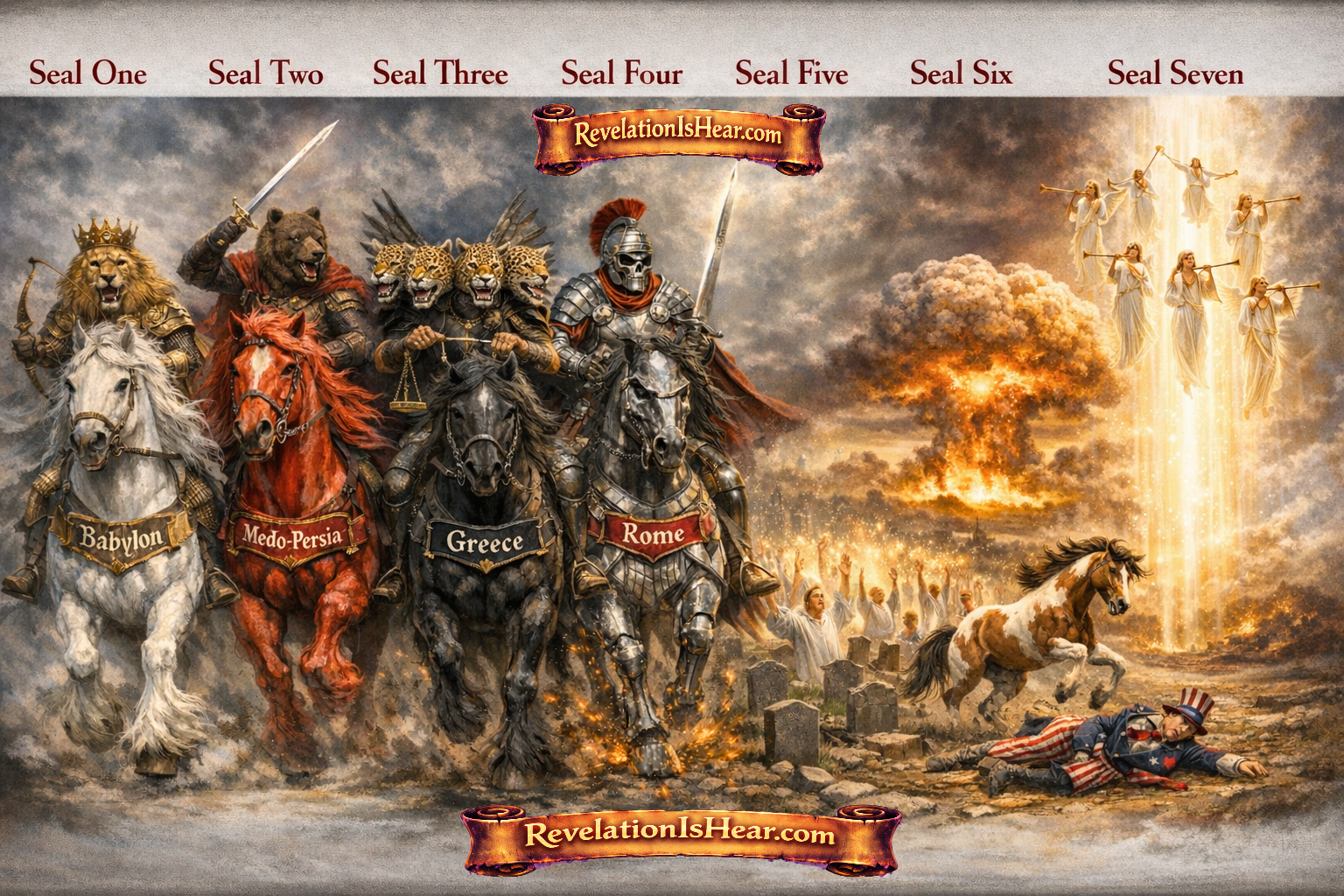
This section follows the seven seals as a single continuous timeline. Seals 1 thru 6 describe events that can be observed in completed history, where the biblical text aligns with known historical developments. Seal 7 continues the same progression in time but describes events in the future. The events in the seventh seal are seven last plagues, portrayed as seven trumpets sounding and are found in Revelation chapters 8, 9 and in chapter 11 verse 16 to 24. The best way to understand the purpose of the seals is to perceive them as a chapter directory of time from Babylon to the return of Jesus and the resurrection.

Part A: The First Six Seals

Part A traces the rise, fall, absence, and reappearance of world powers as presented through the first six seals.

Seal 1: White Horse Signifies Babylon

Went forth conquering and to conquer.

The Neo-Babylonian Empire rose to dominance in the late seventh and early sixth centuries BC through a series of decisive military campaigns led by Nabopolassar and his son Nebuchadnezzar II. Babylon's armies employed disciplined infantry, archers, chariot units, and advanced siege tactics to defeat Assyria, Egypt, Judah, and surrounding kingdoms. Victories at Carchemish (605 BC) and the subsequent western campaigns established Babylon as the supreme imperial power of the Near East. Its conquests brought regional kings under Babylonian authority, effectively placing a crown of empire upon the city as it expanded through continual warfare and territorial domination.

Seal 2: Red Horse Signifies Persia

Took peace from the earth through war.

The Persian Empire rose through relentless military expansion under Cyrus the Great and his successors, uniting the Medes and Persians into a war machine that shattered the balance of power across the ancient world. Persia conquered Lydia, Babylon, Egypt, and much of the known Near East through massive infantry formations, elite Immortals, cavalry, and steel-forged weapons. Its campaigns redrew the political map of the world, overthrowing kingdoms and igniting widespread warfare among nations. Peace was taken from the earth as rival empires collapsed and peoples were drawn into continual conflict under the swing of Persia's great imperial sword.

Seal 3: Black Horse Signifies Greece

Scales for commerce in oil wine grain pottery..

The Greek Empire rose under Alexander the Great through lightning-fast military conquest, but its lasting legacy became one of economic control and commercial administration. After Alexander's death, his empire was divided among his generals, and the Hellenistic kingdoms ruled through taxation, trade regulation, and centralized markets. Grain, oil, and wine became the backbone of imperial revenue, carefully measured, priced, and distributed across vast territories. Under Greek rule, daily necessities were weighed by the scales of commerce, and survival itself became tied to wages, reflecting an empire governed as much by economics as by the sword.

Seal 4: Pale Horse Signifies Rome

Death and Hell followed through persecution and crucifixion.

The Roman Empire rose to dominance through overwhelming military force and iron discipline, bringing vast territories under its control through relentless conquest. Rome's legions crushed resistance with the sword, imposed crushing taxation that led to famine in conquered provinces, and spread pestilence along its vast trade and military networks. Its rule was enforced through terror, public executions, and mass crucifixions, making death a constant presence across its domain. Under Roman authority, Christ Himself was condemned and crucified, marking Rome as the empire under which death and the grave marched openly through the world.

Seal 5: No Horse Signifies How Long

long period with an absence of a dominant world power

After Rome's fall, mankind entered a long period with no dominant world power. It appeared that Daniel's statue, that is head of gold (Babylon), breast and arms of silver (Persia), belly and thighs of brass (Greece), and legs of iron (Rome), had been fulfilled, yet no new kingdom had emerged to follow.

When would the final kingdom appear, that is the feet and ten toes of iron mixed with clay? (Daniel 2:41 thru 43)

The men who died in Christ cry out, asking how long it will be until their blood is avenged upon those still dwelling on the earth. They are given white robes and told to wait, until their brethren should die as they did.

Seal 6: Unprecedented Appearance of Power

The visual description and narrative that define the justification of another Power

The sixth seal contains a narrative describing a vivid event and display of overwhelming power that sent men running for cover. There was a great earthquake. The sun turned black like sackcloth made of goat hair, the whole moon turned blood red, and the stars in the sky fell to earth, as figs drop from a fig tree when shaken by a strong wind. The heavens receded like an Inverted SCROLL being ROLLED up, and every mountain and island was removed from its place. Then the kings of the earth, the princes, the generals, the rich, the mighty, and everyone else, both slave and free, hid in caves and among the rocks of the mountains. They called to the mountains and the rocks, "Fall on us and hide us from the face of him who sits on the throne and from the wrath of the Lamb! For the great day of their wrath has come, and who can withstand it?". After these things I saw FOUR ANGELS holding the four winds so they would not blow on the earth, sea, or any tree. Then I saw another angel with a loud voice say to the FOUR ANGELS that could do harm to the earth and sea, saying, "Do not harm the earth, sea, or the trees till we have sealed the servants of our God". These FOUR ANGELS in the sixth seal are told to prevent this event from happening again until God's servants who are yet to come have been completed. From this description a hypothesis of interpretation is presented and is supported by the upcoming interpretation of the two horned beast. This destructive force being withheld, will be seen again in the opening of the Seventh Seal, which contains the seven Trumpets. When the sixth of seven, Trumpet sounds, these FOUR ANGELS are released from the EUPHRATES river.

Physical Description of Detonation: A mushroom cloud forms because the extreme heat of a nuclear detonation rapidly creates a buoyant fireball that rises upward creating a convection column. The motion slows and spreads outward, causing the cloud to ROLL back on itself in a mushroom shaped cap above.

Harry S Truman's inference to the EUPHRATES River that restrained the FOUR ANGELS was about as prophetic as you can get. President Harry S Truman (Diary entry, 19 45) After being briefed on the bomb recorded "We have discovered the most terrible bomb in the history of the world.", and "It may be the fire destruction prophesied in the EUPHRATES Valley Era, after Noah and his fabulous Ark."

The Construction of a Pivotal Hypothesis

The post 19 45 United States exhibited a historically unprecedented power gap over all other nations, surpassing the relative dominance of any major empire in the previous millennium. Its exclusive nuclear capability, industrial output, and global military reach, demanded the unconditional surrender of Japan on August 15 in 19 45 without homeland devastation. The above scriptural description points to the emergence of a new and unprecedented world power. The hypothesis derived from the interpretation of the sixth seal becomes the foundation on which all other interpretations of Revelation and Daniel are based. This understanding makes this timeline flow seamlessly on through the seven last plagues of the seventh seal. That is the next event in this timeline, and the world awaits its arrival. The first test of this hypothesis is "does it align with Daniel's statue", the head of gold (Babylon), the breast and arms of silver (Persia), the belly and thighs of brass (Greece), and the legs of iron (Rome). The United States corresponds to the feet and ten toes of iron and clay. This alignment holds true so far, although the toes will be addressed in Chapter 4. part B. The hypothesis is that: "The United States is the next world power after Rome." With this hypothesis, a timeline begins to emerge in the Seven Seals prophecy, in which the opening of the Seventh Seal becomes the closing event in this sequence.

Authoritative Physical Description:

Physical description of the power.

A mushroom cloud forms because the extreme heat of a nuclear detonation rapidly creates a buoyant fireball that rises through the atmosphere. As the fireball ascends, it entrains surrounding cooler air, producing a powerful upward convection column. When the rising mass reaches a stable atmospheric layer, vertical motion slows and spreads outward, causing the cloud to ROLL back on itself and form a toroidal, mushroom shaped cap above a narrower stem.

Deriving a hypothesis means developing a specific, testable, and educated guess or proposed explanation for a phenomenon, usually stemming from broader theories or observations, and then turning it into a concrete "if-then" prediction that can be scientifically tested through experiments or studies

Authoritative Quotes and Visual Descriptions (partial):

Quotes and visual descriptions.

Victor F Weisskopf: Senior physicist

Manhattan Project Declassified "...the sky returned to its normal darkness...reddish glowing smoke ball rising...shock wave through the cloud expanding circle"

Edwin McMillan, Physicist, later Nobel laureate, observed at Trinity "sphere which soon turned red"

Robert Oppenheimer (Manhattan Project Director) "Now I am become Death, the destroyer of worlds".

This quotation is from the Bhagavad Gita General.

Thomas F Farrell (Deputy Commander, Manhattan Project) "The effects...unprecedented...stupendous and terrifying. The strong, sustained, awesome roar warned of doomsday...blasphemous to dare tamper with the forces heretofore reserved to The Almighty."

Manhattan Project Scientists (Los Alamos recollections, summarized) "Many scientists felt they had unlocked forces of nature previously attributed only to gods."

Part B: The Seventh Seal

Seal 7 includes Interpretation box.

The seventh seal continues the same prophetic timeline established in the first six seals but describes events that have not yet occurred. The main goal of this section is to show that the Seventh Seal is a continuation of the events described in the Sixth Seal. Recognizing that the FOUR ANGELS were stopping nuclear war from happening again in the sixth seal, then letting it happen in this seal shows continuity in the narrative. The continuity then signifies the event was a man-made event from the wording used in the Trumpets and Vials description. It being a man-made event supports the earlier hypothesis that: "The United States is the next world power after Rome." This hypothesis will aid in the interpretation of these future events. The wording of the first four plagues consistently describes fire entering the earth's atmosphere and producing widespread destruction. Because these events have not yet occurred it prevents direct historical alignment, so an expandable interpretation section is provided. The seven vials are incorporated into this section alongside the trumpets because of their similarities. ( Revelation 16 ). The same events from two different perspectives, presented together to provide the fullest textual picture before interpretation is considered. It is noteworthy that the first four Trumpets address the effects on the earth and the first four Vials address the effects on mankind from the same event. Interpretation sections may be directly quoted from Scripture, interpreted from biblical patterns, derived or inferred from prior recorded events ( fulfilled or unfulfilled ), assumed where Scripture is silent, or supported where applicable by established scientific facts. These elements are combined to explain the reasoning behind speculative models illustrating how such events could plausibly occur. They are not presented as definitive physical mechanisms nor as doctrinal claims.

Trumpet 1 and Vials 1: Fire Ignites the Earth

Trumpet - Fiery hail is cast upon the earth. A third of the trees and all the green grass are burnt up.

Vials - There fell a noisome and grievous sore upon mankind (burns).

Trumpet 2 and Vials 2: The Burning Mountain

Trumpet - A massive fragment like a burning mountain strikes the sea. A third of the creatures and ships are destroyed.

Vials - The sea became as the blood of a dead man and every soul died that was at sea.

Trumpet 3 and Vials 3: Wormwood

Trumpet - Burning fire contaminates drinking water, killing many men by turning waters bitter and deadly.

Vials - There is a poisoning of fresh water supplies making it undrinkable when the water turns to blood.

Trumpet 4 and Vials 4: Sun and Darkness

Trumpet - The skies darken with an obstruction that makes the intensity a third as bright as it usually is from the sun, moon and stars.

Vials - The sun scorches men with fire because of the moisture in the upper stratosphere, triggering a horrific greenhouse effect with higher atmospheric pressure and the super heating of the upper atmosphere.

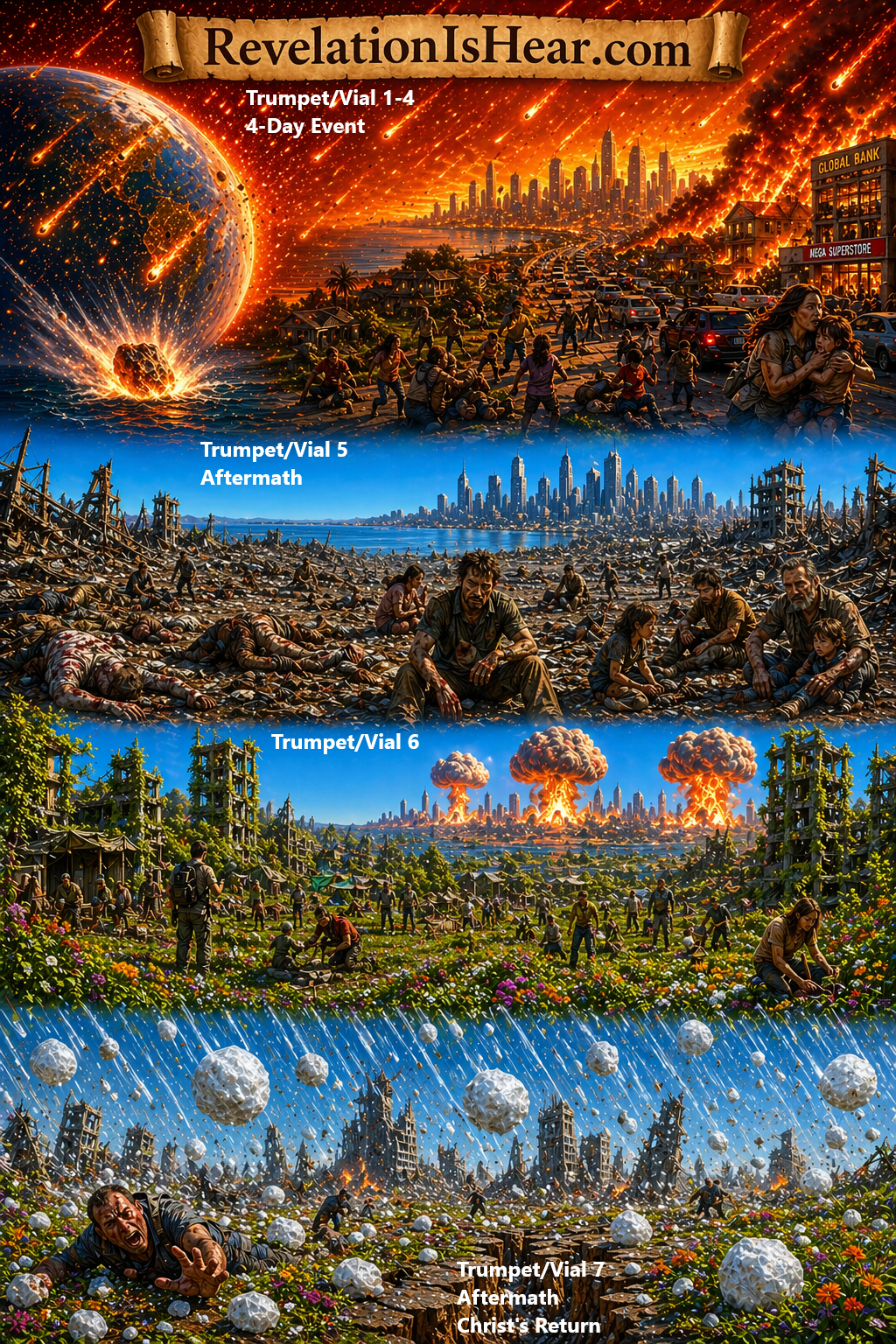
Interpretation of First Four Plagues-Being a single event lasting four days.

Second Peter 3:10 states; "the day of the Lord will come as a thief in the night; in which the heavens shall pass away with a great noise, and the elements shall melt with fervent heat, the earth also and the works that are therein shall be burned up." The first four plagues are one event when the earth crosses the path of a sulfur-based meteor field. The debris entering at extreme velocity will heat up from the friction with earth's atmosphere resulting in a fiery tar like substance raining down along with larger burning pieces. From man's perspective it will strike the earth in twelve-hour cycles as the planet completes four full rotations until the bombardment ends. The four plagues described would be a single event. Four plagues for one event symbolize the severity and duration of this event. A reasonable assumption when compared to Joseph's interpretation of the seven cows and the seven ears of corn representing years. Four hours would be too brief to support the language used here, while four weeks would leave no life remaining on the earth.

To further bolster this interpretation immediately after the fourth trumpet, the narrative pauses with a warning of "woe, woe, woe"...by the next angels. Again after the fifth trumpet another pause in the narrative, one woe past, come two more. Again after the sixth trumpet another narrative pause, second woe past, third woe cometh quickly. (Revelation 11:14) There is no pause in the narrative between the first four trumpets. They are one event. Likewise, after the fourth vial, the narrative reflects back on what has just occurred, stating that men cursed God because He had power over these plagues. Again after the fifth vial men blasphemed God because this plague of monetary collapse was the result of the first four vials. After the sixth vial nothing because God did not cause this plague, it's a man made plague of Nuclear War. This interpretation will be important to build on to support the following interpretations of the other plagues, especially the last one.

Trumpet 5 and Vials 5: Collapse of Currency and Government

Trumpet - Out of the smoke came locusts upon the earth to harm only the men of the earth. The men will be tormented for five months like the sting of a scorpion. The locusts have heads with crowns of gold and faces of men, and tails like scorpions.

Vials - The vial is poured on the seat of the beast and the kingdoms of this world are thrown into darkness.

Interpretation of the Fifth Plague-The governments and monetary system.

The chain reactions from the natural disaster of the first four plagues will result in the collapse of infrastructure. The monetary system will crash and the loss of property and lives will be overwhelming. Currency will cease to exist. No money, credit card, ATM transactions, paycheck or work. It will come to a stop. Governments go hand in hand with the monetary system. This brings supply chains, communication, electrical power and shelter to a halt. This won't hurt the earth, only the men on the earth. The governments in the world will be in chaos and unable to give relief to anybody till they regroup. There will be five months where staying alive and finding food, drinking water and clothes will seem impossible. Medical supplies to treat people with infections from horrific burns will be hard to find and it will feel like the sting of a scorpion.

Trumpet 6 and Vials 6: EUPHRATES and the FOUR ANGELS

Trumpet - In the sixth sounding, the FOUR ANGELS, that were holding back nuclear warfare in the sixth seal, are now released. A third of mankind is killed. The power is in their heads and tails. This is the work of their hands. Mankind made the idols of gold and silver that cannot see, hear or walk. Daniel calls this the god of forces.

Vials - "And the sixth angel poured out his vial upon the great river EUPHRATES; and the water thereof was dried up, that the way of the kings of the east might be prepared." The vials confirm a great war where they are working the miracles, "Armageddon."

Interpretation of the Sixth Plague-The FOUR ANGELS released.

This plague signifies the desperation of mankind at their Darkest Hour. The idols that they have made are now going to destroy them. The FOUR ANGELS that were bound at the EUPHRATES river have been released. The world has been in a desperate position since the fire and sulfur rained down three and a half years earlier. Nuclear weapons have not been used in Warfare since the Hiroshima Nagasaki incident described in the 6th seal. The great river EUPHRATES will dry up from the lack of rain upon the earth due to the greenhouse effect. This river is the sign just before nuclear warfare again. Scripture says "For their power is in their mouth, and in their tails: for their tails were like unto serpents, and heads, and with them they do hurt." Revelation 9:19 thru 20. This sixth plague is nuclear war where a third of mankind is killed. This destructive power issued fire, smoke and brimstone representing heat and nuclear fallout. This destructive power is in their nuclear warhead and tail propulsion (ICBM). Mankind is making and worshiping idols and repented not of the works of their hands. The Nations of the North and East are causing unrest and an unclean spirit from Satan, the beast, and the false prophet go out into the world, working miracles. They gather for that great battle of Armageddon.

Trumpet 7 and Vials 7: Great Earthquake and 50 to 100 Pound Hail

Trumpet - The nations were angry and God's wrath has arrived. The time to judge the dead is arriving and to destroy them which destroy the earth with an earthquake and great hail.

Vials - It is done. A great and mighty earthquake stronger than anything in the history of mankind, so mighty, so great. The great city was divided into three parts, and the cities of the nations fell. Every island fled away, and the mountains were not found. And there fell upon men a great hail out of heaven, every stone about the weight of a talent: and men blasphemed God because of the plague of the hail; for the plague thereof was exceeding great.

Interpretation of the Seventh Plague-Ice chunks and great earthquake

A runaway greenhouse effect occurs when the greenhouse effect spirals out of control, trapping heat and causing rapid warming. It is triggered by a positive feedback loop where greenhouse gases, like water vapor, build up in the atmosphere, blocking heat from escaping into space. This warming can lead to more water vapor in the atmosphere, further intensifying the greenhouse effect. This is what happens during this runaway greenhouse effect brought on by 4 days of fire and sulfur. This is going to be a massive amount of sulfur more than likely containing a small percentage of magnesium. An archaeologist found what he believed to be Sodom and Gomorrah, and discovered one-and-a-half-inch pure sulfur balls. This event, according to Biblical scripture, will not be the first time this has happened. When earth makes contact with this debris field, this sulfur starts heating the upper atmosphere. This sulfur will ignite because of its velocity when going through the air molecules up in our stratosphere. Near-pure sulfur with a magnesium mixture can burn at one thousand to sixteen hundred degrees Fahrenheit (sixteen hundred to three thousand degrees Celsius). This heating of the atmosphere, as the Earth is rotating, is going to generate a massive tidal wave of wind current following the entrance point of this hot debris as the Earth rotates. On the second day, a substantial meteor hit the ocean.

A 2,000-foot meteor would send about 2.2 trillion gallons of moisture well past our stratosphere. No matter what the size of this meteor, it is going to put a substantial amount of moisture up into the stratosphere from the updraft wave that is encircling the Earth as it spins. This heated upper stratosphere is now ready to accept the moisture without losing it due to condensation. The higher the pressures and temperature, the higher the volume of moisture that the air contains. This results in moisture reaching a geosynchronous orbit around the earth, pushing out our stratosphere. Four days of this continual heating around the Earth as it spins will usher in the Runaway Greenhouse Effect. By the 4th day, when this phenomenon begins, the heat felt on mankind due to the pressures and humidity will be immense. With three and a half years of this self-perpetuating rebuilding of the globe of water from the oceans, they will be much smaller than now. Eventually, the amount of moisture available from the oceans will decrease and will bring an equilibrium to this process.

The conditions are now right, from the first four plagues, to make this last plague plausible. This seventh plague of a great earthquake and hail happens immediately after the 6th plague of nuclear warfare, emphasized in Revelation 11:14. The second Woe is past and behold, the third Woe cometh quickly. For hail to become that large, it needs to be aloft for a lot longer than what we experience now. Softball-sized hail takes about 30 minutes under just the right conditions. The lift required to keep it in the air requires 100-mile-an-hour sustained updraft for 30 minutes. So putting it in perspective, one-hundred-pound hail of eighteen inches in diameter takes 12 gallons of water and 250-mile-an-hour updrafts for at least four to six hours. This will not be the way to achieve such a goal; it's going to take a lot more than that. There are 166 million square miles of Earth's surface that lie between the 60° North and 55° Southern parallel. This middle area of the Earth is considered tillable for crop production and populated due to the friendly environment. If one hailstone that size hit every 2,500 square feet in this 166 million square miles, it would take 22.2 trillion gallons of water. To make this feasible, it still needs downsizing. There is a way that hail could just fall on the earth's surface and not in the oceans. Just the area of the land, not counting the ocean surface, is 52.3 million square miles between the north and south parallel. With the oceans shrinking over the last three and a half years, due to the evaporation process started with the runaway greenhouse effect, there will be much more undeveloped land exposed but unlikely any bombing targets.

That would now only require 7 trillion gallons of water. That is equivalent to 4 inches of rain in 100,000 square miles. This would be like four inches of rain on the state of Colorado or the entire area of the United Kingdom, and does not seem insurmountable in this light. This is now feasible with a mechanism to get it aloft and a way that hail could just fall on the earth's surface and not in the oceans. This event needs to be more localized to populated areas to achieve such a goal. The mechanism to do this has just taken place in the sixth plague of nuclear warfare in the last trumpet. The amount of water vapor driven upward in a nuclear detonation will be more than adequate.

Approximate practical estimates of water a 0.015 MegaTon bomb would generate are 100 million gallons in normal atmospheric conditions. Now our new climate is running higher pressures, temperature, and humidity. This could easily double the amount of moisture ejected upward through the heat column into the stratosphere, putting it in a weak orbit. A hailstone of 100 pounds requires about 12 gallons of water. This means that for a nuclear bomb the size of Hiroshima we could expect 50 million 100-pound hail from each nuclear bomb. The detonation of a nuclear bomb would result in a large hail soon after, depending on its elevation at formation. It will be hitting the earth at 200 to 250 miles per hour. It will fall back to earth in relative close proximity to the detonation point depending on wind currents. This explains the seventh plague of hail weighing a talent (75 to 125 pounds, or 34 to 57 kilograms) and the great earthquake where islands that existed before can't be found, and the high mountains are leveled.

As the ocean's volume is dramatically reduced in three and a half years, the lack of back pressure from the oceans on the tectonic plates would let them shift suddenly and violently. Mankind having a nuclear war is not a good idea with the fragile situation these tectonic plates will be in.

There are some biblical scriptures we're going to bring in for this interpretation. In Genesis 1:7 it says, "And God made the firmament, and divided the waters which were under the firmament from the waters which were above the firmament." The biblical account of Noah also states that Noah was given a rainbow as a sign that God would not destroy the Earth with water as long as they saw it. The flood would have been the collapse of this globe of water that gave a terrarium effect to this planet. This terrarium effect would have resulted in higher humidity and atmospheric pressures. This would have made it impossible to have had rain, which is needed for a rainbow. Man's lifespan of 600 to 700 years was drastically reduced to 70 or 80 years without the protection that this globe gave from radiation.

This gives us a plausible explanation that aligns with God's intentions for the End of Time. This greenhouse effect on our planet with higher atmospheric pressure, humidity, and temperature would result in a green, lush vegetation-covered earth. "Behold, I make all things new." (Revelation 21:5)

3. The Seven-Headed Beast (Revelation 13:1)

This chapter explains the seven heads and ten horns on the Beast.

This chapter examines the Seven-Headed Beast and its relationship with God's people. Each head represents the rise and fall of world powers in a continuous timeline that also shows a period when the Beast was headless. This chapter will track who God's people are during each stage and what happens to them.

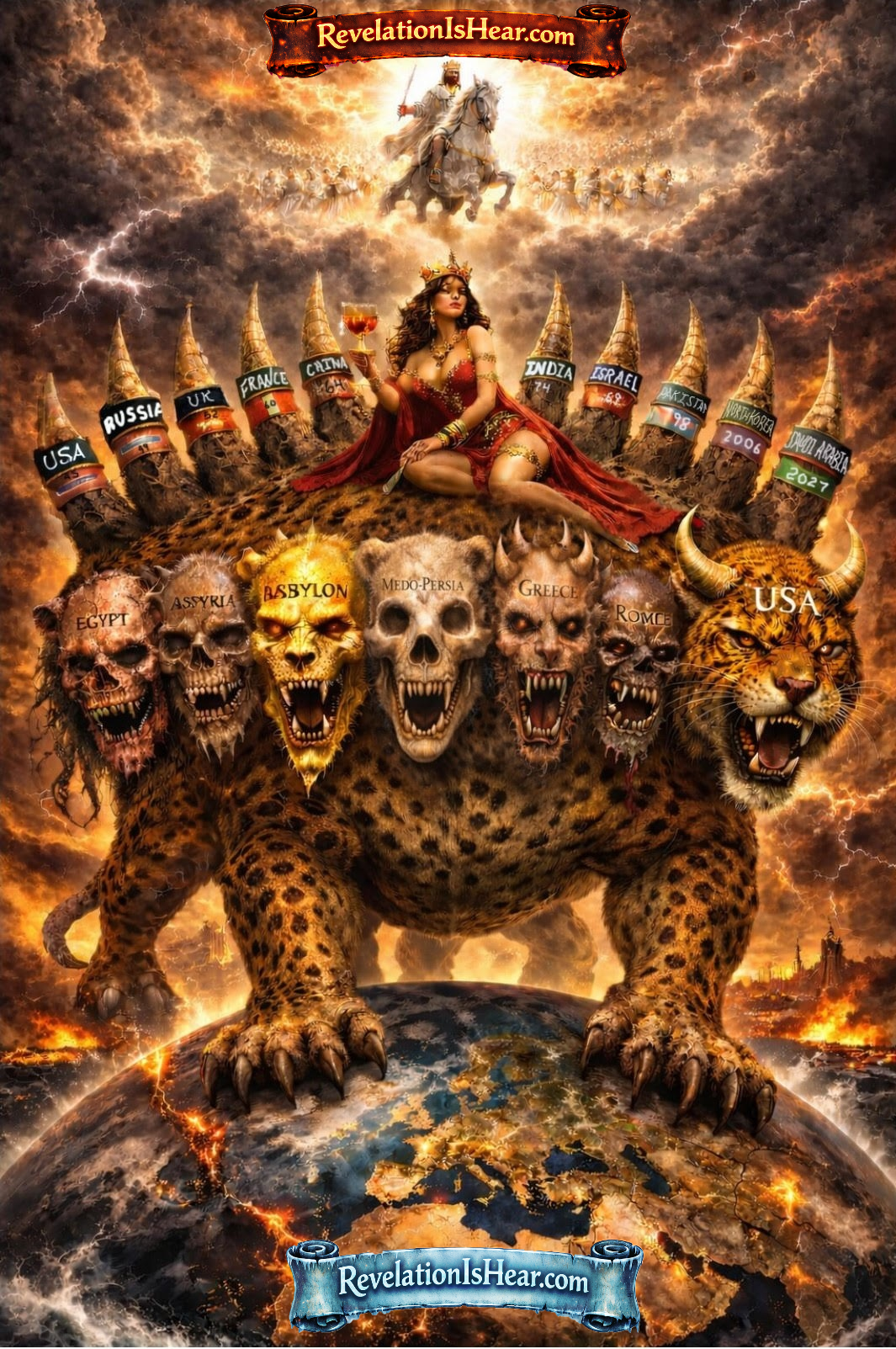
The Beast coming out of the sea symbolizes the restructuring of kingdoms that rule over the same geographical regions and peoples. This Beast has ten horns, which are not placed on the heads because heads come and go. In order for the horns to remain present throughout the timeline, they must be carried on the body of the Beast. Although the ten horns do not become significant until the very end, they are a permanent descriptive feature of the whole picture.

The first six heads flow through history in close succession until the decline of Rome. After Rome's fall, the world entered a long period in which no singular dominant world empire existed, lasting roughly fifteen hundred years, a period described in Revelation as: "one of its heads seemed to have a mortal wound."

The third, fourth, fifth and sixth heads on the Seven Headed Beast are the same kingdoms as Daniel's four Beasts. Daniel's four Beast represent 5 powers and will be examined at the same time because they align with the same ending power.

1. Egypt

First heads relationship to God's people

From the biblical perspective, Egypt stands as the first great world power to openly enslave and oppress God's people. Egypt held Israel in bondage for centuries, forcing them into hard labor and attempting to destroy them through state-ordered infanticide. God confronted Egypt through Moses with signs and plagues, demonstrating His supremacy over Egypt's gods and breaking Pharaoh's power. The Exodus marked God's public deliverance of His people and the downfall of Egypt's claim to divine authority. In Scripture, Egypt becomes a lasting symbol of oppression, idolatry, and human power set in defiance against the God of Israel.

2. Assyria

Second heads relationship to God's people

From the biblical perspective, Assyria emerges as a dominant imperial power used by God as an instrument of judgment against Israel's disobedience. Assyria conquered the Northern Kingdom of Israel in 722 BC, destroying Samaria and carrying the people into captivity. The prophets describe Assyria as "the rod of mine anger" (Isaiah 10:5), sent to discipline Israel, yet Assyria itself became proud and violent. When Assyria later threatened Judah and Jerusalem, God intervened and destroyed its army, demonstrating that Assyria's power was limited and accountable to Him. In Scripture, Assyria stands as both a tool of divine judgment and a warning against imperial arrogance.

3. Babylon

Daniel, head of gold Babylon's relationship

From the biblical perspective, Babylon stands as the empire that brought Judah's kingdom to an end and carried God's people into captivity. Babylon destroyed Jerusalem, burned the Temple, and exiled the people to a foreign land under Nebuchadnezzar. Through the captivity, God humbled His people and demonstrated His sovereignty over kings and nations. At the same time, God showed His power within Babylon itself by preserving Daniel and his companions and by humbling Nebuchadnezzar when he claimed divine authority. In Scripture, Babylon becomes both the agent of judgment against Judah and a lasting symbol of human pride, idolatry, and opposition to God's rule.

Daniel's first beast is "like a lion, and had eagle's wings," and it later stands "upon the feet as a man" with "a man's heart" given to it (Daniel 7:4). In Daniel's own narrative, Nebuchadnezzar is explicitly described as being driven into a beast-like condition and later restored to human reason (Daniel 4:33 to 36), which provides a direct Babylon-era reference point for why Daniel's first beast includes both animal imagery and a return to a "man" state. Revelation signals that its Seven Headed Beast intentionally draws on Daniel's beasts (Revelation 13:2), with these descriptive features and they are not incidental.

4. Persia

Daniel-beast & arms of silver relationship

From the biblical perspective, Persia stands as the empire God raised up to restore His people after the Babylonian captivity. Under Cyrus the Great, Persia conquered Babylon and issued the decree allowing the Jews to return to Jerusalem and rebuild the Temple. Persian kings provided protection, resources, and legal authority for the restoration of Jewish worship and national life. Through Persia, God fulfilled His promises spoken by the prophets, showing that He rules over empires and directs kings to accomplish His purposes. In Scripture, Persia is remembered not as an oppressor, but as the instrument of Israel's restoration.

Daniel's second beast is "like to a bear," "raised up itself on one side," with "three ribs in the mouth of it" and it is commanded, "arise, devour much flesh". (Daniel 7:5) The bear raised up on one side signifies the power of the Medo-Persian Empire with the Persian Empire being the dominant. The ribs in its mouth represent the three Empires that it conquered, which were Babylon, Lydia and Egypt.

5. Greece

Daniel, belly and arms of brass relationship

From the biblical perspective, Greece emerges as the empire that spread its language, culture, and political control across the lands of God's people following the conquests of Alexander the Great. After Alexander's death, his divided kingdom brought Israel under foreign rule, leading to periods of oppression. At the same time, Greek rule laid the groundwork for the spread of the Scriptures through the Greek language, making the Old Testament accessible across the world. In Scripture, Greece stands as both a power of domination and a stage on which God prepared the world for the coming of Christ.

Daniel's third beast is "like a leopard," with "four wings," and it has "four heads," and "dominion was given to it" (Daniel 7:6). The text describes speed (wings), breadth (dominion), and a later multi-headed phase (four heads), which fits with history After Alexander the Great's death. His vast empire was divided among his top generals, the Diadochi, leading to the formation of four major Hellenistic kingdoms. The first was the Ptolemy kingdom, ruling Egypt, the second was the Seleucus kingdom, ruling Syria, Mesopotamia, and Persia. The third, Cassander ruling Macedonia/Greece, and fourth, Lysimachus ruling Thrace/Asia Minor, though these territories constantly shifted in the subsequent decades of war.

6. Rome

Daniel, legs of iron relationship

From the biblical perspective, Rome stands as the empire under which God's redemptive plan reached its decisive turning point. Rome ruled the land of Israel with military authority, imposed heavy taxation, and governed through appointed rulers such as Herod and Pontius Pilate. Under Roman law and power, Jesus Christ was tried, condemned, and crucified. Rome also became the persecutor of the early church, imprisoning and executing believers who refused to worship Caesar. In Scripture, Rome represents the world power that presided over both the rejection of Christ and the birth of the Christian church.

Daniel's fourth beast is described as "dreadful and terrible, and strong exceedingly," with "great iron teeth," and it "devoured and brake in pieces, and stamped the residue with the feet of it," and it is "diverse from all the beasts that were before it" (Daniel 7:7 and 7:19). This matches Rome's historical profile as the Mediterranean imperial military power. This fourth beast "had ten horns" (Daniel 7:7), and those horns are treated as the birthing ground for the stouter horn that will be addressed in chapter 5, Daniel's Four Beasts. We now have a long gap between Rome and the rise of the 7th head. This historical void of a world power for 1300 years is the reason for Revelation's language: "one of his heads as it were wounded to death" (Revelation 13:3). This would be after the fall of Rome.

"One of its heads seemed to have a mortal wound."

After the fall of Rome, it appeared that another dominant world empire would never rise again. Rather than one ruling power, the world entered a long period defined by multiple kingdoms and empires ruling simultaneously across Europe, the Middle East, Africa, and Asia. None could achieve global dominance. Geography itself prevented it. Mountains, jungles, deserts, and oceans formed natural walls that limited expansion and made permanent worldwide control unrealistic. Distance, slow travel, and delayed communication made centralized rule across continents impossible.

Global dominance only became possible when technology removed these barriers. Steamships and railroads collapsed distance. The telegraph and radio enabled instant communication. Internal combustion engines transformed logistics and mobility. Aircraft made the world reachable within hours. Only with these developments could a single power maintain true global reach.

Birth of a New Nation

Out of this changing world emerged a new nation where God's people, that is Jew and Gentile alike, could live with a land of their own, where no tyranny could dictate worship. Unlike Europe, there would be no church-run government and no government-run church. Dissenters such as Puritans, Baptists, Quakers, Catholics, and others had been persecuted, barred from public office, and imprisoned. The founders had seen firsthand that when government controls religion, it leads to corruption, coercion, and persecution.

The founders wanted freedom of religion because they had seen what happens when church and state are merged. Their goal was not to remove religion from society, but to protect it. In 17 76 the American founders were openly God-fearing in worldview and language. The Declaration of Independence grounds human rights in a Creator, speaks of "the Laws of Nature and of Nature's God," and appeals to "the Supreme Judge of the world." Later national symbols such as "In God We Trust" reflect that same religious culture. As John Adams stated, "Our Constitution was made only for a moral and religious people. It is wholly inadequate to the government of any other."

The United States is unique in history for being founded by a Christian culture, grounded in biblical moral assumptions, explicitly affirming God as the source of rights, yet refusing to create a state church. No other nation combined a biblical worldview, natural-law philosophy, individual liberty, freedom of conscience, and separation of church from political control.

Closing Statement

Now the stage is set: its mortal wound is about to be healed, the whole earth marveled, and they said, "Who is like the beast, and who can fight against it?" Here comes the seventh head.

7. United States (19 45)

Daniel, feet and ten toes of iron and clay

Revelation describes this Beast with seven heads and ten horns, and the next statement sounds like Daniel's words. This unique correlation makes it impossible to discuss without also examining Daniel's visions on this subject. In the words of John, "the beast which I saw was like unto a leopard, and his feet were as the feet of a bear, and his mouth as the mouth of a lion," which are the exact beasts used by Daniel (Revelation 13:2). This intentional phrasing shows that the third, fourth, fifth, and sixth heads on this Seven-Headed Beast are the same kingdoms as Daniel's Four Beasts. After investigating the identity of the seventh head on its own, we will address that in chapter five, Daniels four Beasts. Revelation then describes a critical transition: "I saw one of his heads as it were wounded to death; and his deadly wound was healed: and all the world wondered after the beast" (Revelation 13:3). If the "wound" is tied to the collapse of Rome's single-empire dominance and the long era of a headless beast marked by the absence of world power, then the "healing" requires a historically identifiable re-emergence of global dominance that is recognized as unmatched. The text reinforces this through the world's response: "Who is like unto the beast? who is able to make war with him?" (Revelation 13:4). The emergence of this nation with nuclear power is so overwhelming that it makes the identification undeniable. This power has a measurable amount of time during which it exercises this authority; it says, "and to exercise its authority for forty-two months." Reason dictates that this seventh head must hold this status by itself, not alongside another comparable power. This beast has only one head, not two, and the moment another nation gains even partial authority, that head loses its singular status. History records the 42-month window and how it is terminated, by the seventh head leading the world into a new phase of ultimate power distribution. That transition will be addressed in chapter 4. The Two-Horned Beast, Part B.

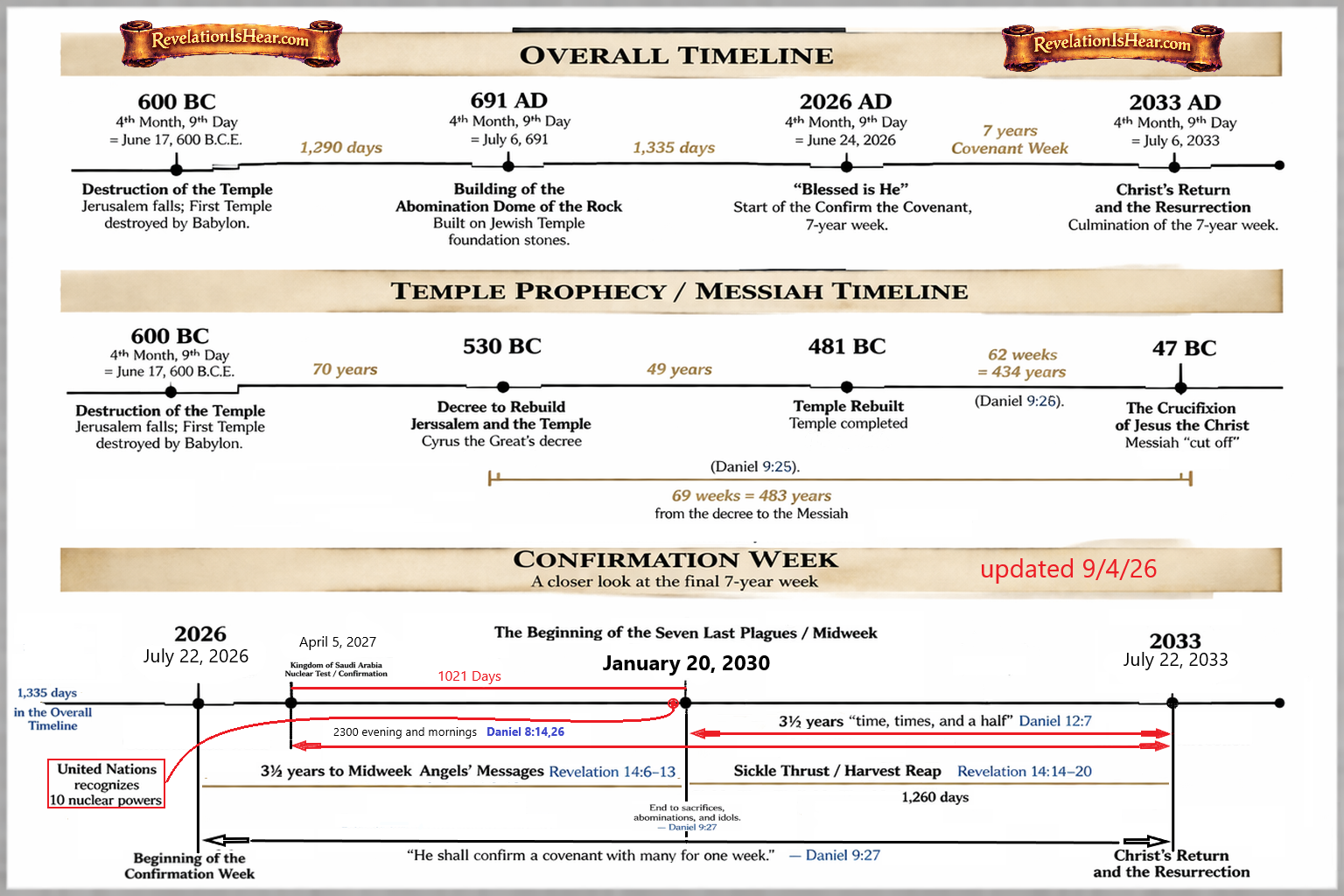
From October 24, 19 45, to April 4, 19 49, is exactly 42 months. Using both boundary dates in the count as full days, this period totals 1,260 days. This authority window began when the UNITED NATIONS Charter entered into force on October of 45', creating a new world security system. Under this system, five nations were given permanent veto power on the UNITED NATIONS-Security Council, granting them legal control to authorize or block global military action. Three of those five nations, that is the United States, Britain, and France, later became core founding leaders of NATO. This meant that the same countries leading the world's largest military alliance also controlled whether the UNITED NATIONS could approve or block wars.

During this period, the United States alone possessed atomic weapons and global military reach, giving it the ability to strike anywhere on the planet. The 42-month window from October 24th, of 45', to April 4th, of 49', is the only time in history when a single nation held both formal world authority through the UNITED NATIONS and, with its nuclear power if needed, absolute military supremacy to exercise that authority. This status ended with the founding of NATO on April 4th, of 19n49 . The framework was built on collective defense, commonly summarized as an attack on one member being treated as an attack on all. In later years, NATO developed nuclear-sharing arrangements in which United States nuclear weapons were stationed in allied countries under agreed control frameworks.

This alliance ended the singular status held by the United States for 42 months and transformed it into a collective. That transition toward an irreversible multipolar situation was confirmed when Russia tested its first nuclear weapon on August 29, 19n49.

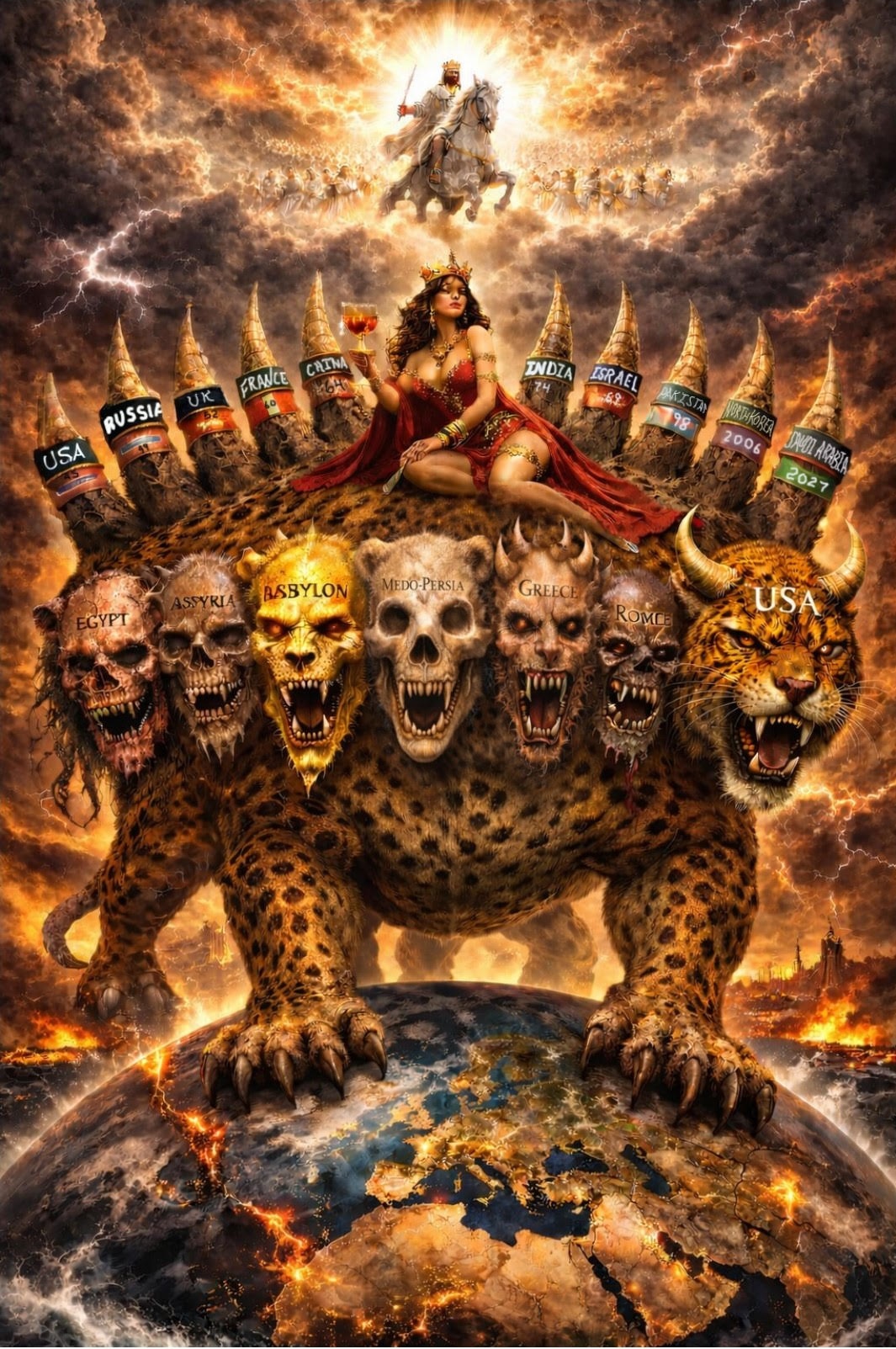
Daniel's four beasts have been aligned with the Seven Headed Beast as follows: Babylon is represented with a lion, aligning with the third head of seven on the Revelation beast. Medo Persia represented a bear, aligning with the fourth head on Revelations' beast. Greece represented a leopard, aligning with the fifth head and Rome represented a dreadful, strong, terrible beast with iron teeth by Daniel, aligning with the sixth head in Revelation. The sixth head on this seven headed beast is not the last representation here. The Rome alignment with the Fourth Beast has more to offer, it has horns. Those horns carry over far into the future, thirteen hundred years later, with the stouter horn. Chapter 5 will address the strong horn on the Fourth Beast and its relationship to the seventh head, with an in-depth look. It shows that the sturdy horn is the Seventh Head because of this 42-month window, equal to time, times and a half to give an identification of the United States. This history-prophecy comparison substantiates the conclusion that the United States is the seventh head on the Beast.

4. The Two-Horned Beast: Part A and Part B: The Image

This chapter explores the two-horned beast and its role with the image that comes to life with the ten kings.

Part A: Revelation's Last World Power

First part of the two-horned beast analysis.

Understanding the Two-Horned Beast

The Two-Horned Beast just seems to be tacked on to the end of the seven-headed beast described in the previous verses. If the seven-headed beast is the world, then what does this represent? An afterthought maybe? No. This can only be a closer look at the seventh head of the beast which came back to life. This Two Horned Beast description would be like taking a magnifying glass to the seventh head. The next identifying characteristics discribed will be aligned with the United States history in 19n45.

List of Identifying Characteristics:

  1. Another beast coming up out of the ground: representing a new government in a new geographical area (America).
  2. Two horns: representing two seats of power President and Vice President.
  3. Like a lamb and spake as a dragon: representing the willingness to let other nations have their sovereignty and not out to conquer the world, even though it had the power to do just that. Since it had that power, when the dragon spoke you better listen.
  4. Exercises all the power of the first (seven headed) beast: because it is the beast described in the previous verses that has come back to life with a new head. The world now worships the beast again.
  5. This beast doeth great wonders of fire coming down from heaven: fulfilled in the atomic bombings of Hiroshima and Nagasaki in 19 45.
  6. Because it could perform this miracle of fire, it made the world want an IMAGE of the beast: Even the United States wanted this IMAGE to prevent another world war. This would keep them from being the only country to stop aggression and promote the sovereignty of every nation. Even at the risk of being under the oversight of this IMAGE, it would perform better than flying solo in the overall world politics. The United States was pushing for a world governing system, exercising peer pressure, to avoid future wars. This IMAGE would be worshiped because of the power it would have. The world, awed by atomic fire, was led into acceptance of the United States leadership to form the UNITED NATIONS. A strong ally in this nuclear world was now necessary. The UNITED NATIONS Charter was signed June 26, 19 45, and entered into force October 24, 19 45.
  7. This two horned beast not only created this IMAGE but it also gives life unto the IMAGE: In the beginning, the United States, by Hosting the UNITED NATIONS in New York, providing significant funding upon its creation and then, the final breath of life, NATO (in 19 49) brought this IMAGE to life. That was the end of the Seven Headed Beast status and the birth of the first of the ten horns. Once this "IMAGE" comes to life it will be able to sustain itself from the collective support of the whole world.
  8. This beast also makes everyone in its control receive a mark in their right hand or in their forehead: In the "Principles for Reading" Section it shows biblically that this represents physical possession and memorization depicting the wording, in their forehead. This possession of a Social Security Card displaying a Social Security Number, and having the Social Security Number memorized fits perfectly. This was enforced indirectly by requiring a social security number to obtain work or bank account years later. The important thing here is, the first complete full cycle of the modern United States withholding system (continuous paycheck withholding followed by annual filing and refund/balance settlement) was completed in March 19 45. Prior to the tax system we have now, taxes were paid on a voluntary system, due in one lump sum. Taxes were not withheld as they are now. No man can buy or sell without the mark, or the name, or the number of his name.
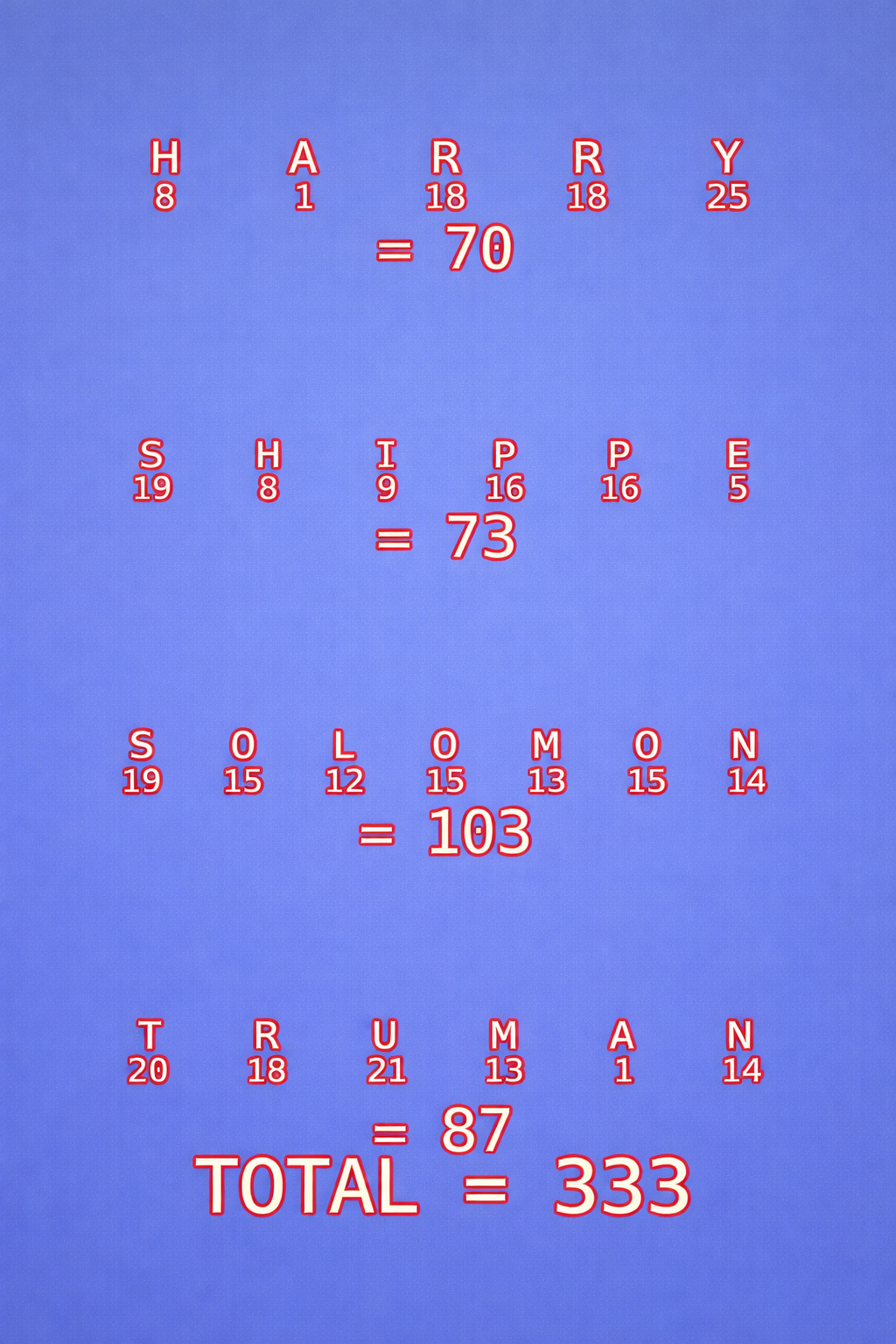
  9. The Positive Identifying Attribute of this beast is (6 6 6), via the number of a man: This man would be the head and obvious symbol of the United States leadership. The other identifying features happened in 19 45. Who was the Man of the hour in 19 45? Harry S Truman started the year out as Vice President, and ended the year as President in 19 45. He was our thirty third President, and a thirty third degree Mason. Remember this is a two-horned beast representing two seats of power. Harry S Truman filled both that year. The letter "S" represented both Shipp (paternal) and Solomon (maternal) to honor Harry's Grandfathers. Digging deep in history reveals the spelling of Shipp is Shippe, and his daughter, Margaret Truman, used the spelling "Shippe" as well. There is a note on the S in his name being used instead of the two full names on his birth certificate. Harry's own words on his name were that he had no middle name, that it was just "S" for two names. He supposed that it was easier than two initials for signing, "S", "S", and this way a single S simplified his signature, although he did usually use a period after the , "S". The other factor in this single S, the parents of Harry did not want to imply precedence of one grandfather over the other by holding the first location in his name. Using Gematria, A equals one; B equals two; thru; Z; equals twenty six, the values are as follows: Harry is seventy, Shippe is seventy three, Solomon is one hundred three, and Truman is eighty seven. That gives a value of (3 3 3). This is the number of a man, and it is a very unique set of circumstances, controversy and confusion around this one simple fact: what was a man's name;
Gematria calculation: Harry Shippe Solomon Truman = 333
Download Image
Revelation 13 imagery: 1945, 666, two-horned beast, fire from heaven

:Here is wisdom, count the number of the beast . It is the number of a man and it is (6 6 6).

This Beast is a two horned Beast and Harry S Truman filled both seats of power that year. Two seats of power, one man. Since we are counting the number of the Beast, not the number of a man, it's the man's number times two for the two seats of power. The number of the man is (3 3 3). The number of the beast would then be (6 6 6). It is now established, way beyond a reasonable doubt, that the seventh head on the seven headed beast, is the United States, verified through Revelation's forty two month window. It is also, in the same manner, confirmed beyond a reasonable doubt, the same fact, the United States is the seventh head, verified through the time, times, and a half in Daniel. The above math of a name alone is a hard, probable fact the two Horned Beast is the United States as well. This Two Horned Beast description would be like taking a magnifying glass to the seventh head is a true, and conclusive statement. The hypothesis was that: "The United States is the next world power after Rome." and has been proven. Now, not a hypothesis any more, but proven multilaterally. The conclusion of the ten horns are now in the radar and it's the only thing needing to be addressed, and will be studied next.

Documentation on the spelling "Shippe"

Not found easily

Shippe with an e is attested in genealogical sources (Geneastar) and even in mail Truman personally received addressed as "Harry Shippe Truman." Here are two identified published biographies that use the spelling Shippe rather than Shipp. One is Harry S Truman by Margaret Truman, where the spelling Shippe appears on page 50. The other is Harry S Truman, President by Thomas Fleming, where the same spelling appears at the beginning of Chapter 2 (page 47). Both works use the spelling Shippe. Thomas Fleming was selected by President Truman to collaborate with Margaret Truman on her biographies of her parents. Margaret Truman, as a direct family member and biographer with access to Truman family knowledge, represents one of the most authoritative in print sources for how the family understood and presented the spelling of ancestral names. The same spelling makes it unlikely that the spelling was a simple typographical error. The Autobiography of Harry S Truman was used as reference for above information on his middle name, "S". For calculation, Shippe is preserved, though both forms existed historically.

Part B: The Ten Horns on the Seven Headed Beast

Analysis of the ten horns and two horned beast created image.

This section lines up the image in the last section with the UNITED NATIONS and the Beast, comparing it to recent history and the world governing structure currently in place.

Revelation seventeen, verse three: "So he carried me away in the spirit into the wilderness: and I saw a woman sit upon a scarlet coloured beast, full of names of blasphemy, having seven heads and ten horns."

Revelation seventeen, verse seven: "And the angel said unto me, Wherefore didst thou marvel? I will tell thee the mystery of the woman, and of the beast that carrieth her, which hath the seven heads and ten horns."

Revelation seventeen, verse eight: "The beast that thou sawest was, and is not; and shall ascend out of the bottomless pit, and go into perdition: and they that dwell on the earth shall wonder, whose names were not written in the book of life from the foundation of the world, when they behold the beast that was, and is not, and yet is;"

  • The beast that thou sawest was: This is the beast when it had a head from Egypt until Rome;
  • and is not: This is the period when there was no world power for fifteen hundred years;
  • and yet is: This is the resurrection of the beast via the United States.

Revelation seventeen, verse nine: "And here is the mind which hath wisdom."

Revelation seventeen, verse ten: "And there are seven kings: five are fallen, and one is, and the other is not yet come; and when he cometh, he must continue a short space;"

  • And there are seven kings, five are fallen. At the time this was written down, two thousand years ago, there were five fallen kingdoms. They are Egypt, Assyria, Babylon, Medo Persia and Greece.
  • and one is: Rome "is" at the time this is written;
  • and the other is not yet come; and when he cometh, he must continue a short space: This is the United States, and it held its singular status for forty-two months.

In Part A of this chapter, the 7th head (United States) set up an IMAGE and gave it life. Franklin D Roosevelt was the architect for the UNITED NATIONS and played a significant role in its birth. Franklin D Roosevelt, along with Winston Churchill and other nations, signed the Declaration of 19 42, hoping to establish an organization that would prevent another world war. Roosevelt never got to see his vision come to life in 45' it was President Harry S Truman who saw it on October 24th. The concept behind the UNITED NATIONS was a good concept, and would still work with nuclear nations if it were balancing nuclear nations. The idea of a collective governing the world works until you have one nation with such a power gap that it negates the effectiveness of the collective. This IMAGE needed to come to life with nuclear power for enough strength to control a rogue nuclear nation by the collective. The control would be impossible without other nuclear powers to put the singular status of the United States in check. When the United States relinquished its sole status in April of 49', the IMAGE turned into a collective power. The collective power of three permanent seats on the UNITED NATIONS Security Council gave the IMAGE the power that was needed so desperately. This is the point where the IMAGE is not only receiving life from just the United States but from the NATO nations as well. This nuclear power balance was later firmly established in 49' with Russia's positive nuclear test. This was a smart move on the United States' part, establishing the UNITED NATIONS power before Russia acquired it. Even with the United States putting itself under the subjection and oversight of the UNITED NATIONS, it was better to have the UNITED NATIONS, with the collective members, controlling through the Security Council.

Revelation seventeen, verse eleven: "And the beast that was, and is not, even he is the eighth, and is of the seven, and goeth into perdition:" This is worded as the "beast," not "the beast having seven heads and ten horns." This is a headless beast representing the new power structure: the UNITED NATIONS. The IMAGE is the UNITED NATIONS before it came to life. The "Beast" is the UNITED NATIONS when it came to life with two or more supporters that had nuclear power.

By establishing the powerful collective, they warded off any aggression by hostile countries. This took the pressure off the United States as a singular opposition, transferring it to a collective for maintaining world peace. NATO did destroy the singular status of the 7th head (United States) at this point, but it definitely gave power unto the IMAGE. This now puts the ten kings into perspective and clarifies what they represent. Revelation says that ten kings, represented by the horns, reign with the Beast for an hour. NATO not only killed the seventh head but ushered in a new power distribution mechanism. This is referred to in the Bible as the 8th and is of the seven: the beast itself without need of a head, because the IMAGE is now the 8th world power with nuclear nations.

Revelation seventeen, verse twelve: "And the ten horns which thou sawest are ten kings, which have received no kingdom as yet; but receive power as kings one hour with the beast."

Revelation seventeen, verse thirteen: "These have one mind, and shall give their power and strength unto the beast."

It started with the United States being the first horn, and there will be horns added in succession until all ten have come into being. We are on the ninth horn, waiting for the last horn at this point in history. With this IMAGE, the Beast no longer needs a singular head. We have just reframed the power structure of the Beast to a collective. The Beast without a head is now the eighth world power, seen through the IMAGE that was created and brought to life. The United States was the first horn in 19 49, with Russia being the second. The third was the United Kingdom in 52', the fourth was France in 60'. The fifth was China in 64', the sixth was India in 74'. The seventh, Israel in 67', and eighth was Pakistan in 98'. The ninth power is where we are right now and it's North Korea. Saudi Arabia is going to soon be the tenth and final power. This first horn (UNITED STATES) shares its power as long as NATO is intact. There are nine nuclear nations at this point, waiting for the tenth to arise as described in Daniel chapter eleven. The ten horns that are illustrated align with the ten toes on the statue of Daniel that was addressed in Chapter 2, Part A, the sixth seal, and this completes the explanation of Daniel's statue.

Revelation fourteen, verse four: "These are they which were not defiled with women; for they are virgins. These are they which follow the Lamb whithersoever he goeth." The woman that turns into a Harlot, that rides the beast with seven heads and ten horns, would be any organized Christian or Abraham-based sect that does not perceive idol worship the same way that Revelation and Daniel do. She ends up being the Mother of Harlots and Abominations of the Earth. Revelation 17:5.

In chapter 12 verse 1 of Revelation this woman was the bride of Christ. She had a crown of 12 stars on her head and was giving birth. This same bride becomes the Harlot that rides the Beast when it becomes a nuclear power. Before that she was untouchable and in a place where she was nourished for a time times and a half. She did not need protection anymore at the birth of the United States. This was a kingdom, based on Christianity where she could be accepted and protected. On July 16, 516CE, Byzantine Emperor Anastasius I sent an imperial embassy to Rome, attempting to bribe papal legates and bypass Pope Hormisdas by appealing directly to the Roman Senate. In 516CE King Theodoric and the Roman Senate remained loyal to Pope Hormisdas, rejecting the Emperor's attempts to undermine the Papacy. 516CE was a critical year of high-stakes diplomatic maneuvering that reinforced the authority of the Pope in Rome over the Eastern Church. The problem here is that Rome was about to collapse. But the church had been ordered to stay under the Papacy rule for unity before Rome fell. The Catholic church was the protector of the Bride for a Time, Times and a half or 1260 days. In Prophecy, when a day equals a year, this works perfectly. 516 CE plus 1,260 days equals 17 76. The problem here is that this new nation turned corrupt in 19 45 along with the bride.

5. Daniel's Four Beasts

This chapter examines the first horn on the seven headed Beast.

1. Babylon

In Daniel 7:4, the first beast is described as being "like a lion, and had eagle's wings," later standing "upon the feet as a man" with "a man's heart." This imagery mirrors the narrative of Nebuchadnezzar in Daniel 4:33 thru 36, where he is driven into a beast-like state before being restored to human reason. This provides a direct Babylonian-era reference for the transition between animal and human characteristics.

That unique correlation (back in Chapter 3 section 7) of the lion, bear, and leopard in Revelation 13:2 is very apparent now. Its relevance is impossible to ignore and the narrative was not incidental.

2. Persia

Daniel's second beast is "like to a bear," "raised up itself on one side," with "three ribs in the mouth of it" and it is commanded, "arise, devour much flesh". (Daniel 7:5) The bear raised up on one side signifies the power of the Medo-Persian Empire with the Persian Empire being the dominant. The ribs in its mouth represent the three Empires that it conquered, which were Babylon, Lydia and Egypt.

3. The Grecian Empire

Daniel's third beast is "like a leopard," with "four wings," and it has "four heads," and "dominion was given to it" (Daniel 7:6). The text describes speed (wings), breadth (dominion), and a later multi-headed phase (four heads), which fits with history after Alexander the Great's death. His vast empire (Greece) was divided among his top generals, the Diadochi, leading to the formation of four major Hellenistic kingdoms. The first was the Ptolemy kingdom, ruling Egypt, the second was the Seleucus kingdom, ruling Syria, Mesopotamia, and Persia. The third, Cassander ruling Macedonia/Greece, and fourth, Lysimachus ruling Thrace/Asia Minor, though these territories constantly shifted during the subsequent decades of war.

4. Rome

Daniel's fourth beast is described as "dreadful and terrible, and strong exceedingly," with "great iron teeth," and it "devoured and brake in pieces, and stamped the residue with the feet of it," and it is "diverse from all the beasts that were before it" (Daniel 7:7 and 7:19). This matches Rome's historical profile as the Mediterranean imperial military power. This fourth beast "had ten horns" (Daniel 7:7), and those horns are treated as the birthing ground for the little horn that arises out of the ten. We now have Babylon the lion, Mede-Persia the bear, the leopard Greece, and the dreadful beast being Rome. The next power takes some history alignment to unlock its identity. We now have a long gap between Rome and the rise of the next power, so this covers several hundred years. Remember that for another world power to exist, technology needs to advance substantially in order to maintain dominance in a world that has quadrupled in size with huge natural barriers.

5. The Horns

The dreadful beast in the last section, that represents Rome, has ten horns with another stouter horn that arises from within them. Make sure there is no confusion here. The ten horns of Daniel are not the same as the ten horns of Revelation. The ten horns of Daniel are what the more powerful, eleventh horn arises from the midst of. The ten horns of Revelation are on the back of the seven headed beast, and don't reveal their meaning until later. They have no bearing on each other. Between the three accounts in Daniel chapter seven, the new horn begins in the birthing ground of ten kingdoms. The horn that arises will subdue three of the ten kings from that era when it rises to maturity. (Daniel 7:8) History establishes the kingdoms as: Great Britain, France, Spain, Portugal, Austria, Prussia, Russia, the Ottoman Empire, Tokugawa Shogunate (Japan), and Denmark-Norway in the 17 76 time marker. The problem is that two of the kings were under a new flag by 19 45. The Prussia and Austria kings were now the backbone and absorbed by Germany. Germany accounts for two of the three, the Tokugawa Shogunate in 17 76, which is Japan in 19 45, will make the third and fulfill the verse "subdue three of the ten" because Japan is from the 17 76 era. In another account (Daniel 7:24) it will subdue three kings of the 19 45 era. Since the original three are now two, one more would be needed, and Spain would be the third in that scenario and fulfill the prophecy, it's covered either way. By 19 45 three major militarized imperial states were not merely defeated but dismantled and removed from the world-power structure. The United States was the major force in this action along with the Soviet Union and the United Kingdom. The clincher here, "they shall be given into his hand until a time, times and the dividing of time". (Daniel 7:25)

This was definitely a clever and candid hint to look at the four beasts of Daniel from that description of the seven headed beast in Revelation chapter thirteen. What an astonishing clue, the clue sends you to Daniel, and Daniel points you back to Revelation and comes right back to the 7th head. Again aligning, just as the 7th head on the Beast of Revelation did with the 42 month window, but now it's the, "time, times and a half", fitting the same time frame. Once again from October 24, 19 45, the charter of the UNITED NATIONS, until the signing of the NATO treaty, on April 4, 19 49, was exactly 42 months, which equals three and a half years given into his hand. This authority window is the strongest time-bounded test, and supports the hypothesis that "The United States is the next head on the seven headed beast."

Summary

This 19 45 alignment now confirms the Seventh Head to be the first nuclear power of the ten in a 80 year span till it is fulfilled. Yes, the United States is the first horn on the back of the Seven Headed Beast. The last and final tenth horn on this beast is going to be the biggest challenge to identify, which is in the next chapter, "6. Daniel's Two Beasts". The working hypothesis that the United States is the next world power after Rome is now a biblical fact.

6. Daniel's Two Beasts

This chapter examines the 10th horn on the seven headed beast.

The Book of Daniel is an astounding book with an underlying current that emphasizes the importance of worshiping the one true God. There appears to be a timeline from the defilement of the first temple to the defilement of the second temple, anchored in a solid Gregorian date, with a continuation from there to the last defilement of God's sanctuary which has not happened yet. (Daniel 12:11 and 12). There also appears to be three more, smaller timelines: the first beginning at the defilement of the first temple and ending at the sixty ninth week and the seventh week at the end of the 1335 years (the covenant week), just before Jesus' return. Jeremiah 25:11. Daniel 9:2. Daniel 9:24 thru 27. The second spans from the defilement of God's sanctuary until the sanctuary is cleansed (Daniel 8:14). The third is an allotted time for the "time of trouble," ending with the resurrection (Daniel 12:7).

The end result of this long and detailed trail arrives at the doorsteps of the "Kingdom of Saudi Arabia." This kingdom has not completely fulfilled all of the prophecy, but it is unmistakably positioned to do so. (Daniel 11) Saudi Arabia will be the last nuclear nation to arise and become the final (the tenth) horn on the back of the seven-headed beast of Revelation.

This journey is presented in four expandable sections. The first section aligns with conventional religious interpretations of ( Daniel 11 verse one to verse fifteen ). The second section enters new territory for most people, offering a fresh perspective and tracing the narrative from Rome to the Kingdom of Saudi Arabia through the Egyptian province (Daniel 11 verse sixteen to verse twenty-eight). The third section addresses future events that have not yet taken place. These events are presented in a clear and straightforward manner, allowing the reader to understand without interpretation (verse twenty-nine to verse forty-five). The fourth section addresses Daniel chapters 8, 9, and 12 and the timeline they reveal. This timeline is also integrated with the prophecy of the temple and the crucifixion of Christ.

A. Accepted analysis

Daniel verse one to verse fifteen

Explanation of vision time frame:

Daniel received this vision in chapter 8, verse 1, "In the third year of the reign of King Belshazzar." The explanation of the vision was given to him in chapter 10, verse 1, "In the third year of Cyrus king of Persia a thing was revealed unto Daniel, but the time appointed was long: and he understood the thing, and had understanding of the vision." When the angel was starting to make him understand, he fainted and was strengthened. They then continue in chapter 11 with, "Also I in the first year of Darius the Mede," which is taken as an intentional timing marker (Cyrus in his third year). Cyrus was king while Darius the Mede was a satrap (regional governor) under Cyrus.

verse one

Also I in the first year of Darius the Mede, even I, stood to confirm and to strengthen him.

verse two

And now will I shew thee the truth. Behold, there shall stand up yet three kings in Persia; and the fourth shall be far richer than they all: and by his strength through his riches he shall stir up all against the realm of Grecia.

1st king: (559 to 530 BCE) Cyrus the Great (founder of the Persian Empire), king at the time this explanation was given to Daniel.

Three more kings:

2nd king: (530 to 522 BCE) Cambyses the second, son of Cyrus. Conquered Egypt.

3rd king: (522 to 486 BCE) Darius the first (Darius the Great). Organized the empire, rebuilt Babylon, and allowed temple rebuilding.

4th king: (486 to 465 BCE) Xerxes the first. The famous king of Esther and the massive invasion of Greece.

The Fourth King: the rich one who attacks Greece: Xerxes the first. The wealthiest Persian ruler, he assembled one of the largest armies in ancient history and launched the massive invasion of Greece (480 BCE), fighting at Thermopylae, Salamis, and Plataea. This invasion provoked Greece and directly set the stage for Alexander the Great's revenge conquests a century later.

verse three

And a mighty king shall stand up, that shall rule with great dominion, and do according to his will.

(336 BCE) Alexander the Great.

verse four

And when he shall stand up, his kingdom shall be broken, and shall be divided toward the four winds of heaven; and not to his posterity, nor according to his dominion which he ruled: for his kingdom shall be plucked up, even for others beside those.

(334 to 323 BCE) Alexander conquered the Persian Empire in 10 years and ruled from Greece to India.

(323 BCE) He died suddenly at age 32 in Babylon. Alexander did not lose his empire in war; it collapsed instantly at his death. He left no adult heir, no successor, and no governing structure. Within weeks, generals were fighting for control.

"Not to his posterity": Alexander had a half-brother, Philip the third (mentally disabled), and a newborn son, Alexander the fourth. Both were murdered within a few years. His bloodline ended; no son ever ruled.

"Divided to the four winds of heaven": After 20 years of wars (the Wars of the Diadochi), the empire settled into four major kingdoms ruled by Alexander's generals:

  • West is Macedonia & Greece and was Cassander.
  • North is Thrace & Asia Minor and was Lysimachus.
  • East is Syria & Mesopotamia and was Seleucus.
  • South is Egypt and was Ptolemy.

These are the four winds, four directions.

verse five

And the king of the south shall be strong, and one of his princes; and he shall be strong above him, and have dominion; his dominion shall be a great dominion.

King of the South is Egypt and was the Ptolemaic dynasty.

King of the North is Syria and was the seleucid dynasty.

Israel sat directly between them.

(323 to 282 BCE) The King of the South was Ptolemy the first Soter, Pharaoh of Egypt, founder of the Ptolemaic dynasty, and ruler of the richest and most stable Hellenistic kingdom. Egypt became the economic powerhouse of the Mediterranean world.

"One of his princes shall be strong above him": Seleucus the first Nicator was originally one of Ptolemy's generals. He served under Ptolemy and was given command in Babylon, later broke away, and built his own empire. Seleucus eventually ruled Syria, Mesopotamia, Persia, and parts of India, and his empire became larger than Egypt.

"He shall be strong above him and have dominion": Seleucus became more powerful than Ptolemy. His territory was vastly larger, militarily dominant, and the strongest of the successor kingdoms. This marks the birth of the Seleucid Empire, the future King of the North.

"His dominion shall be a great dominion": Seleucus ruled the largest empire since Alexander. He founded Antioch, the future Seleucid capital.

verse six

And in the end of years they shall join themselves together; for the king's daughter of the south shall come to the king of the north to make an agreement: but she shall not retain the power of the arm; neither shall he stand, nor his arm: but she shall be given up, and they that brought her, and he that begat her, and he that strengthened her in these times.

(285 to 246 BCE) Ptolemy the second Philadelphus, at this point in history, is the king of the south.

(261 to 246 BCE) Antiochus the second Theos is the king of the north.

Berenice Syra, that is the king of the south's daughter, was the daughter of Ptolemy the second of Egypt.

The political marriage: After years of war between Egypt and Syria, a peace treaty was arranged. The agreement was that Antiochus the second would divorce his wife Laodice, marry Berenice, and their son would inherit the Seleucid throne to unite the two empires, exactly as Daniel said: "The king of the south's daughter shall come to the king of the north to make an agreement."

"She shall not retain the power of the arm": meaning she would not keep political power. What happened? Antiochus the second later returned to Laodice, abandoned Berenice, Laodice poisoned Antiochus, and then had Berenice and her infant son murdered.

"Neither shall he stand, nor his arm": Antiochus the second did not remain king; he was assassinated. His "arm" (his dynasty through Berenice) was destroyed.

"She shall be given up, and they that brought her": Berenice, her child, and her attendants were all killed.

"He that begat her": her father, Ptolemy the second, died shortly after.

"He that strengthened her": her protector and supporters were eliminated.

Historical records confirm this. Ancient historians such as Polybius, Appian, and Josephus record this sequence.

verse seven

But out of a branch of her roots shall one stand up in his estate, which shall come with an army, and shall enter into the fortress of the king of the north, and shall deal against them, and shall prevail:

(246 BCE) "A branch of her roots": this means a close blood relative. Ptolemy the third Euergetes, her brother, became king of Egypt and swore revenge for Berenice Syra and her infant son, who were murdered in Syria.

"Shall stand up in his estate": he succeeded his father. Ptolemy the second died, and Ptolemy the third became king of Egypt.

"Shall come with an army": this was one of the largest military campaigns in Egyptian history, known as the Third Syrian War (Laodicean War).

"Shall enter into the fortress of the king of the north": he invaded the Seleucid Empire (Syria) and captured Antioch (Seleucid capital), Seleucia, and fortresses throughout Syria and Mesopotamia.

"Shall deal against them, and shall prevail."

verse eight

And shall also carry captives into Egypt their gods, with their princes, and with their precious vessels of silver and of gold; and he shall continue more years than the king of the north.

This is still Ptolemy the third Euergetes (Berenice's brother). Historically, after conquering Syria and Mesopotamia, Ptolemy the third captured massive treasure from Seleucid cities, seized idols and temple wealth, and carried them back to Egypt. He recovered Egyptian gods stolen by Persia centuries earlier. Egyptian records celebrate him as "The Restorer of the Gods." That is why he was called Euergetes, "The Benefactor."

verse nine

So the king of the south shall come into his kingdom, and shall return into his own land.

He defeated Seleucid armies, looted Syria, carried massive treasure back to Egypt, and recovered idols previously taken by Persia centuries earlier. Egypt reached its greatest territorial extent under him. Ancient historians include Polybius, Appian, Jerome, and Josephus.

verse ten

But his sons shall be stirred up, and shall assemble a multitude of great forces: and one shall certainly come, and overflow, and pass through: then shall he return, and be stirred up, even to his fortress.

(226 to 223 BCE) Seleucus the third Ceraunus tried first: he raised an army, marched toward Asia Minor, and was assassinated by his own officers. Then his younger brother took over.

(223 to 187 BCE) Antiochus the third the Great. "One shall certainly come, and overflow, and pass through": this is Antiochus the third the Great. He rebuilt the Seleucid military and launched massive campaigns through Syria, Israel, Phoenicia, and Asia Minor. Like a flood, he swept through Egyptian-controlled territory. This is the beginning of the Fourth Syrian War.

"He will return and be stirred up to his fortress": after early campaigns, Antiochus the third regrouped at Antioch (Seleucid capital), reorganized his forces, and launched even greater invasions.

verse eleven

And the king of the south shall be moved with choler, and shall come forth and fight with him, even with the king of the north: and he shall set forth a great multitude; but the multitude shall be given into his hand.

(221 to 204 BCE) The king of the south, Egypt, ruled by Ptolemy the fourth Philopator.

The king of the north, Antiochus the third the Great (Seleucid Empire), aggressively reclaiming territory lost to Egypt, including Israel.

"The king of the south shall be moved with choler": Ptolemy the fourth was furious at Antiochus's invasion, so Egypt mobilized for war.

"Shall go out and fight with him": Ptolemy the fourth personally led his army.

"He shall raise a great multitude": both sides assembled massive armies. Ancient sources record:

  • Egypt (Ptolemy the fourth): 70,000 infantry, 5,000 cavalry, 73 war elephants.
  • Syria (Antiochus the third): 62,000 infantry, 6,000 cavalry, 102 war elephants.

This was one of the largest battles since Alexander.

"But the multitude shall be given into his hand": despite Antiochus's strength, Egypt won at the Battle of Raphia (217 BCE). This was a stunning reversal of Seleucid momentum.

verse twelve

And when he hath taken away the multitude, his heart shall be lifted up; and he shall cast down many ten thousands: but he shall not be strengthened by it.

Still the same two kings:

King of the South is Ptolemy the fourth Philopator, ruler of Egypt.

King of the North is Antiochus the third the Great, ruler of Syria.

(217 BCE) "When he hath taken away the multitude": this refers to Ptolemy the fourth defeating Antiochus the third's army. At Raphia, over 10,000 Seleucid soldiers were killed.

"His heart shall be lifted up": Ptolemy became proud and arrogant. Instead of pressing the advantage, destroying Antiochus permanently, and securing the empire, he celebrated, indulged, became reckless, and abandoned military leadership.

"He shall cast down many ten thousands": Ptolemy had the power at that moment to end the Seleucid threat forever.

"But he shall not be strengthened by it": despite his overwhelming victory, Egypt did not become stronger. Instead of crushing Antiochus, he signed a weak peace treaty. Because Ptolemy the fourth failed to finish Antiochus the third, Antiochus rebuilt his army, reformed his kingdom, launched new campaigns, and returned stronger than ever. Within 20 years, Syria conquered Israel, Egypt lost Palestine permanently, and the Seleucid Empire dominated the region.

verse thirteen

For the king of the north shall return, and shall set forth a multitude greater than the former, and shall certainly come after certain years with a great army and with much riches.

(202 to 200 BCE) "After certain years": the prophecy says there would be a delay after the Battle of Raphia in 217 BCE. Antiochus returned to attack Egypt's territories about 15 to 17 years later.

"Shall raise a greater host than before": a much larger army, better-trained troops, more war elephants, and vast financial resources. He had become one of the most powerful kings since Alexander.

"With a great army and much equipment (riches)": he conquered eastern provinces, took Persian treasuries, restored Seleucid wealth, and funded massive military reforms. This second invasion was on a completely different scale.

What was happening in Egypt? Ptolemy the fourth had died (204 BCE). His son, Ptolemy the fifth, was only 5 years old. Egypt was ruled by corrupt regents, the army had deteriorated, and Egypt was now weak and divided.

verse fourteen

And in those times there shall many stand up against the king of the south: also the robbers of thy people shall exalt themselves to establish the vision; but they shall fall.

(202 to 195 BCE) Fifth Syrian War.

The King of the South is (Ptolemy the fifth, a child king) ruler of Egypt.

The King of the North is Antiochus the third the Great, ruler of the Seleucid Empire.

"Many shall stand up against the king of the south": Egypt was attacked on multiple fronts. Antiochus the third invaded from Syria, Philip the fifth of Macedon attacked from the north, internal revolts broke out inside Egypt, provinces began defecting, and Egypt's empire began to unravel.

"The robbers of thy people": this phrase means violent Jewish factions. In Hebrew, it literally means "the violent ones among your people." These were Jewish groups who hated Egyptian rule, believed Antiochus would bring liberation, rose in rebellion against Egypt, opened Judea's cities to Seleucid forces, and believed they were fulfilling prophecy.

"Shall exalt themselves to establish the vision": they thought the fall of Egypt was God's will, Antiochus was God's chosen instrument, and they were helping bring in God's kingdom, so they joined the Seleucid invasion. Josephus records that many Jews welcomed Antiochus the third into Jerusalem.

"But they shall fall": their hope was misplaced.

verse fifteen

So the king of the north shall come, and cast up a mount, and take the most fenced cities: and the arms of the south shall not withstand, neither his chosen people, neither shall there be any strength to withstand.

(202 to 198 BCE) Antiochus the third's final conquest of Palestine (Battle of Panion). After years of preparation, he invaded Judea and Phoenicia, besieged the Egyptian fortress of Sidon, built siege ramps ("cast up a mount"), and crushed Egypt's elite army under General Scopas. Egypt's best troops were trapped in Sidon and starved into surrender. Antiochus the third never confronted the king of the south (Ptolemaic) again. From here on, any altercations with the north were with Rome.

NOTE: From here on, an applied "continuous-to-the-end" reading of Daniel 11 (per Jesus' reference to the abomination of desolation in Matthew/Mark) is used. Therefore, alignment will diverge from conventional interpretations.

B. Fresh analysis

Daniel verse sixteen to verse twenty-eight

verse sixteen

But he that cometh against him shall do according to his own will, and none shall stand before him: and he shall stand in the glorious land, which by his hand shall be consumed.

(190 BCE) He (Rome) that cometh against him (king of the north) will do his will. Rome devastated Antiochus the third (who won the Battle of Panion in the last verse) with an army a third the size and half the casualties. Antiochus the third (Seleucids) was surprisingly brought to his knees by Rome, even with his 72,000 man army, against Rome's 30,000 men. Antiochus the third sustained 10,000 deaths to Rome's 5,000 men. The king of the north is finished. Antiochus the third signed a truce in 189 BCE, abandoning claims to land west of Taurus and paying a heavy war indemnity. Once Rome has removed the kingdom of the north from ever being a power to contend with again, we see the dynastic timeline give way to imperial powers from here on.

verse seventeen

He shall also set his face to enter with the strength of his whole kingdom, and upright ones with him; thus shall he do: and he shall give him the daughter of women, corrupting her: but she shall not stand on his side, neither be for him.

(47 BCE) Roman restructuring of the Egyptian throne. Julius Caesar entered Egypt in October 48 BCE with the strength of his legions, pursuing Pompey and seeking to secure Egypt's grain and wealth for his military campaigns. Egypt was in dynastic turmoil: the king, Ptolemy the thirteenth (Cleopatra the seventh's younger brother and husband under Ptolemaic custom), had driven Cleopatra from Alexandria and ruled alone. She was in exile when Caesar arrived.

According to Plutarch, Cleopatra had herself smuggled into Caesar's private quarters, rolled in a carpet, and presented herself to him. She became his lover and conceived a son, Caesarion (born June 47 BCE). Caesar was roughly thirty years her senior. When Ptolemy the thirteenth's faction discovered the liaison, conflict erupted. Caesar's forces, besieged in the palace quarter, fought the Alexandrian War (48 to 47 BCE). Ptolemy the thirteenth fled and drowned in the Nile during the Battle of the Nile (47 BCE). Caesar, seeing an opportunity to secure Egypt's resources through a loyal ruler, restored Cleopatra to power. To satisfy dynastic custom and Roman political optics, he gave her a new co-ruler and husband: her second-youngest brother, Ptolemy the fourteenth. The marriage was a political maneuver intended to manage Egypt through royal structure, but it failed to produce lasting alignment or loyalty. Cleopatra retained real power and acted independently of the dynastic solution, causing the strategy to collapse rather than secure Roman aims through succession.

This episode sets the stage for the next verses. Caesar's trusted lieutenant Mark Antony, a relative of Caesar through the Julian family (Antony's grandmother was a sister of Julius Caesar) and a close political ally, would later ally with Cleopatra after Caesar's death. Antony and Cleopatra attempted to establish their own power base in the East, leading to conflict with Caesar's adopted son and heir Octavian. That struggle (verse eighteen to verse nineteen) would end with Antony's defeat and Egypt's absorption into Rome.

verse eighteen

After this shall he turn his face unto the isles, and shall take many: but a prince for his own behalf shall cause the reproach offered by him to cease; without his own reproach he shall cause it to turn upon him.

(32 BCE) Octavian turns Egypt's "reproach" back onto Mark Antony. Octavian consolidated maritime and western power ("the isles") and then moved to neutralize Mark Antony by reframing him as an Eastern prince acting for his own ambition under Cleopatra the seventh. Octavian publicized the Donations of Alexandria (34 BCE), where Antony and Cleopatra distributed titles and territories to their children, to portray Antony as transferring Roman authority toward Egypt. That same year, Octavian illegally seized Antony's will from the custody of the Vestal Virgins and had its contents read publicly, emphasizing Antony's alleged desire for burial in Alexandria and other provisions that inflamed Roman opinion (the authenticity/validity of the will's contents is debated in scholarship, but the political use of it is well attested). By framing the conflict as a war against Cleopatra/Egypt rather than a civil war against a Roman, Octavian persuaded the Senate to strip Antony of authority and declare war on Cleopatra, causing the political disgrace attached to "Egyptian kingship" to fall decisively on Antony. (Supporting detail: Antony's letters mocked Octavian as "Thurinus," which Octavian later described as a "reproach," reflecting how "reproach" language was used as a political weapon in their rivalry.)

verse nineteen

Then he shall turn his face toward the fort of his own land: but he shall stumble and fall, and not be found.

(30 BCE) Antony's final retreat to Egypt ends in collapse. After the defeat at Actium (31 BCE), Mark Antony withdrew to Alexandria, his last stronghold in Egypt. In the final crisis of 30 BCE, Antony attempted suicide by falling on his sword after receiving false news that Cleopatra was dead, and he died shortly after. Cleopatra died soon after as well (commonly dated August 10 or 12, 30 BCE), and Egypt's independent rule ended as Rome absorbed the kingdom.

NOTE:

From this point forward, Daniel's narrative changes in scope. The text no longer dwells on repeated clashes between the kings of the north and south, because Roman intervention effectively ends that pattern of bilateral conflict. With Rome's conquest of Egypt, the former "king of the north" framework (Seleucid) gives way to a succession of occupying powers over the same geographic region.

From this point on, the vision tracks Egypt, not as a dynastic kingdom (Ptolemaic), but as a territory subjected to successive regimes, across a long historical arc. The focus shifts away from individual battles between two kings and toward broader patterns of regime change, occupation, and control of the land. While the ruling powers change, the geography remains the same.

This transition begins with Rome.

verse twenty

Then shall stand up in his estate a raiser of taxes in the glory of the kingdom: but within a few days he shall be destroyed, neither in anger, nor in battle.

(619 to 630 CE) Egypt passes under Persian (Sasanian) control during the Byzantine-Sasanian war, and the occupation is marked by fiscal continuity, keeping revenue flowing through preserved administrative structures. But the end of that Persian phase turns suddenly at the top: after Khosrow the second's fall, the Sasanian state enters rapid turnover, culminating in Shahrbaraz's brief seizure of power and removal after roughly forty days, an abrupt end by internal collapse and assassination rather than by a decisive battlefield defeat.

verse twenty-one

And in his estate shall stand up a vile person, to whom they shall not give the honour of the kingdom: but he shall come in peaceably, and obtain the kingdom by flatteries.

(629 to 630 CE) Emperor Heraclius secured Roman rule with the return of Egypt from Persian occupation through peace terms and negotiated evacuation, including arrangements tied to Shahrbaraz's withdrawal and political realignment. Persian rule in Egypt thus ended largely by treaty and withdrawal rather than by a celebrated battlefield reconquest. At the same time, Heraclius was widely viewed as morally disqualified by the Church due to his 613 CE marriage to his niece Martina, an act condemned as incestuous and uncanonical under established Christian and Roman law. Patriarch Sergius and other church leaders openly opposed the union, regarding it as a grave violation of covenantal standards. In this context, "vile" reflects a contemporary moral judgment: a ruler whose authority was obtained peaceably, yet whose legitimacy was stained by scandal and rejection under religious law.

verse twenty-two

And with the arms of a flood shall they be overflown from before him, and shall be broken; yea, also the prince of the covenant.

(641 to 642 CE) The Arab conquest sweeps through Egypt like a flood, overrunning fortified positions until Alexandria, the last major imperial stronghold, falls under binding surrender terms. The "broken" moment is not merely gradual decline but the legal and military severing of Byzantine authority through enforced agreements, evacuation, tribute, and hostages. In the same hinge, Cyrus of Alexandria, patriarch and imperial prefect who negotiated the settlement, dies in 642, marking a testable "prince of the covenant" endpoint at the exact turnover of rule.

verse twenty-three

And after the league made with him he shall work deceitfully: for he shall come up, and shall become strong with a small people.

(642 to 15 17 CE) After Alexandria's surrender terms fixed the post-Byzantine order in Egypt ("the league"), a comparatively small ruling minority became strong in the province through long administrative consolidation rather than constant open warfare. Control was stabilized by preserving revenue systems and inherited bureaucracy while gradually reshaping law, language, and public life, strength gained through governance and policy as much as armies ("work deceitfully" in method, not merely in one battle). Over the following centuries, Egypt remained a central fiscal and strategic province under successive regimes until the Ottoman conquest in 15 17.

verse twenty-four

He shall enter peaceably even upon the fattest places of the province; and he shall do that which his fathers have not done, nor his fathers' fathers; he shall scatter among them the prey, and spoil, and riches: yea, and he shall forecast his devices against the strong holds, even for a time.

(15 17 to 15 25 CE) With that consolidation complete, the Ottomans absorbed Egypt and entered peaceably into its richest regions, reorganizing the province as a fiscal and administrative engine rather than a battlefield. Wealth was distributed through appointments, stipends, patronage, and controlled provincial finance, "prey, spoil, and riches" used deliberately to secure loyalty, while long-term strategies were maintained against remaining power centers and strongholds for a measured period.

verse twenty-five

And he shall stir up his power and his courage against the king of the south with a great army; and the king of the south shall be stirred up to battle with a very great and mighty army; but he shall not stand: for they shall forecast devices against him.

(17 98 to 18 01 CE) Napoleon invades Egypt and defending forces gather but cannot stand. Napoleon Bonaparte invaded Ottoman Egypt with a large expeditionary force, defeated the defending Mamluk-led armies at the Battle of the Pyramids (July 21, 1798), and then lost strategic freedom when Britain destroyed his fleet at the Battle of the Nile (Aug 1, 1798), setting in motion the eventual expulsion of the French (Napoleon) by British-Ottoman forces (17 98 to 18 01).

verse twenty-six

Yea, they that feed of the portion of his meat shall destroy him, and his army shall overflow: and many shall fall down slain.

In real terms, the Ottoman Empire had become the table through which Egypt's wealth flowed. By the late eighteen hundreds, financial groups centered in Britain and France were already consuming that flow, using Egypt's tribute revenues to service debts the Ottomans had accumulated. Long before World War I, Europe was already feeding at the Ottoman table, drawing value from a system the Ottomans themselves no longer truly controlled.

When war came, Britain did not merely weaken the Ottoman position: it removed it. In December 19 14, Britain formally severed Ottoman suzerainty over Egypt, declared a protectorate, removed Khedive Abbas the second, and installed Hussein Kamel as a new, British-aligned headship. This was not a technical adjustment; it was a moral and structural overthrow. The Ottomans were cut out of the system that had sustained them. The table remained, the revenue, the strategic value, the financial machinery, but the Ottomans were no longer seated at it.

And here is the key point that fits the scripture plainly: the eating did not stop. The same financial interests that had been consuming Egypt's tribute before the break continued to consume it after the break, now directly, without the Ottoman Empire as the middle authority. They destroyed him and then took the whole table. That is exactly what "they that feed of the portion of his meat shall destroy him" means when read without legal loopholes or fine print.

The Ottoman response comes next, just as the verse says: "his army shall overflow." In January to February 19 15, Ottoman forces surged toward Egypt in an attempt to reclaim what had been taken, attacking the Suez Canal. It was a desperate military overflow after a financial and political cutoff. The attempt failed. The losses were heavy. "And many shall fall down slain." Militarily, the Ottomans broke at Suez. Financially, they had already been broken by the loss of the table.

verse twenty-seven

And both these kings' hearts shall be to do mischief, and they shall speak lies at one table; but it shall not prosper: for yet the end shall be at the time appointed.

At this point in Daniel 11, the narrative shifts from open conquest to coordinated deception. The verse describes no battlefield, but a table, where agreements are spoken publicly while intentions are concealed. Historically, this aligns with the First World War period, when Britain and France outwardly portrayed themselves as partners in liberating Arab peoples from Ottoman rule, while privately negotiating how the Middle East would be divided between them.

Between 19 15 and 19 16, Arab leaders were encouraged to revolt against the Ottomans with promises of independence, self-rule, and an Arab homeland. At the same time, those same powers secretly agreed to partition the region for their own interests. These were lies spoken at one table: public diplomacy on one side, private division on the other.

The Arab forces drawn into this conflict did not represent a single nation, but a collection of tribes and regional groups-Hashemite forces from Mecca, fighters from the Hejaz, tribal groups from Nejd, Bedouin confederations across Arabia, and Arab irregulars in Syria, Transjordan, and Mesopotamia. They fought believing they were securing their own future, unaware that that future had already been negotiated without them.

Daniel's statement, "but it shall not prosper," does not mean immediate failure. The strategy succeeded in overthrowing Ottoman control, but it did not produce lasting Arab unity or fulfillment. Instead, foreign mandates replaced empire, imposed borders replaced tribal continuity, and independence remained incomplete. The deception worked temporarily, but the outcome remained unresolved, because, as the verse states, the true end was still appointed for a later time.

verse twenty-eight

Then shall he return into his land with great riches; and his heart shall be against the holy covenant; and he shall do exploits, and return to his own land.

The next verse carries the same people forward. After the war, Arab forces did not return to Europe or foreign lands with plunder. They returned to Arabia itself, the land from which they had originated. From 19 20 to 19 32 CE, Abdulaziz ibn Saud consolidated control over Nejd, the Hejaz, and surrounding territories, culminating in the establishment of the Kingdom of Saudi Arabia in 1932.

The "great riches" described here are not presented as carried wealth, but as the wealth of the land itself. What appeared barren concealed immense resources beneath it. Beginning in 19 38 with the discovery of oil at Dammam, and accelerating after World War II, these resources transformed the Arabian homeland into one of the most resource-rich regions on earth. This economic power was later formalized on the global stage with the creation of OPEC in 19 60, through which oil-producing nations, led by Saudi Arabia, gained collective control over pricing and production. They did not return with riches; they returned to riches.

Abraham stands as the foundational witness to uncompromising monotheism. In ancient records, including extra-biblical traditions such as the Book of Jasher, Abraham is portrayed as rejecting false gods and refusing divided worship. From Abraham came two sons: Isaac, through whom Israel later received the Sinai HOLY COVENANT, and Ishmael, through whom Islam claims inheritance of Abraham's monotheistic legacy. Muhammad's stated mission regarding a HOLY COVENANT was to affirm the oneness of God, establish justice, and protect "People of the Book", (Christians and Jews), with a binding agreement in the Ashtiname (covenant) given to St. Catherine's Monastery. Muhammad's stated mission was not to introduce a new god, but to restore the undivided worship of the God of Abraham without partners or rivals.

This frames the critical phrase: "his heart shall be against the holy covenant." To be "against" the covenant does not require open rejection of the God of Abraham. It indicates a future violation: placing trust, authority, or fear in something elevated alongside God. Up to this point in history, Saudi Arabia has not acquired nuclear weapons, which is significant. It indicates that this verse establishes posture and trajectory, not final action. The verses that follow (Daniel verse twenty-nine to verse forty-five) describe developments that are not yet completed, written as warnings before fulfillment rather than commentary after the fact.

The phrase "he shall do exploits" is acknowledged without exaggeration. As a verb, exploit denotes the use of power or resources for advantage. In historical terms, this is evident in how oil wealth has been leveraged for national influence, most clearly through decades of price-setting authority within OPEC. These actions are recognized here as part of consolidation and influence, not as the final breach described later in the chapter.

The connection between verses 27 and 28 is intentional. The same people deceived and mobilized under false promises in the previous verse emerge here as a consolidated group, returned to their ancestral land, now in possession of its hidden wealth. What did not prosper through lies spoken at one table ultimately led to the formation of a nation that carries the narrative forward into the remaining stages of Daniel 11.

NOTE: From this point on (as of 2026, with no fulfillment yet), there is no further alignment with completed history. What follows is the foretelling of future actions that the Kingdom of Saudi Arabia will take in establishing its rise to nuclear power.

This aligns with the tenth toe of the statue in Daniel and the tenth horn on the seven-headed beast. The lineage of kingdoms traced throughout this chapter exists for one purpose only: to identify this final nuclear power that Jesus referred to in Matthew and Mark when He warned of the "abomination of desolation."

When we reach chapter 12, we are given something entirely different: a firm and truthful timeline revealed to Daniel, intended to be built upon in the vision to come. This timeline is presented as trustworthy. It provides the reader with a defined window for preparation in order to survive the "time of trouble" spoken of by Jesus.

It therefore makes sense that revealing the final power through an eighty-year process (19 45 to 20 26 CE) is the central objective of this chapter 11 prophecy. There is no reason to continue historical alignment beyond this point, except that, at the end (chapter 12), a precise timeline is given, completing the purpose of the vision.

The remaining verses (29 to 45) are therefore self-explanatory, and the reader who has followed the chapter carefully should be able to understand them without difficulty.

C. Future events

Daniel verse twenty-nine to verse forty-five

verse twenty-nine

At the time appointed he shall return, and come toward the south; but it shall not be as the former, or as the latter.

verse thirty

For the ships of Chittim shall come against him: therefore he shall be grieved, and return, and have indignation against the HOLY COVENANT: so shall he do; he shall even return, and have intelligence with them that forsake the HOLY COVENANT.

verse thirty-one

And arms shall stand on his part, and they shall pollute the sanctuary of strength, and shall take away the daily sacrifice, and they shall place the abomination that maketh desolate.

verse thirty-two

And such as do wickedly against the covenant shall he corrupt by flatteries: but the people that do know their God shall be strong, and do exploits.

verse thirty-three

And they that understand among the people shall instruct many: yet they shall fall by the sword, and by flame, by captivity, and by spoil, many days.

verse thirty-four

Now when they shall fall, they shall be holpen with a little help: but many shall cleave to them with flatteries.

verse thirty-five

And some of them of understanding shall fall, to try them, and to purge, and to make them white, even to the time of the end: because it is yet for a time appointed.

verse thirty-six

And the king shall do according to his will; and he shall exalt himself, and magnify himself above every god, and shall speak marvellous things against the God of gods, and shall prosper till the indignation be accomplished: for that that is determined shall be done.

verse thirty-seven

Neither shall he regard the God of his fathers, nor the desire of women, nor regard any god: for he shall magnify himself above all.

Abraham is widely regarded as a foundational example of uncompromising monotheism: the belief that one single, supreme, ultimate God exists and governs the universe. He is the primary patriarch associated with the Abrahamic faiths, including Islam. Ishmael was the son of Abraham and Hagar, and Islam teaches that the covenantal line continues through Ishmael. From Abraham's perspective, however, the covenant is defined by exclusive loyalty to the God of Abraham, and to hold any rival power in esteem alongside Him would be treated as abomination, especially in traditions such as the Book of Jasher, where Abraham is portrayed as actively opposing false gods.

In the biblical framework, the birth of a promised man-child carries covenant significance for Jews and Christians. By contrast, in an Islamic framework, the birth of a child-while valued personally and socially-does not carry covenant or redemptive meaning. When Daniel says that he "shall not regard the desire of women," the statement is not about cruelty, immorality, or disregard for family. It describes a system in which the birth of a man-child holds no covenant significance. Women everywhere desire children, but the significance assigned to that desire differs by history and belief. This distinction fits the historical trajectory and identification described here (Saudi Arabia) and would not apply to cultures such as the United States, where the significance of this birth is most clearly expressed through traditions like Christmas and nativity scenes. The phrase functions as a marker of identity, not a moral condemnation.

verse thirty-eight

But in his estate shall he honour the God of forces: and a god whom his fathers knew not shall he honour with gold, and silver, and with precious stones, and pleasant things.

verse thirty-nine

Thus shall he do in the most strong holds with a strange god, whom he shall acknowledge and increase with glory: and he shall cause them to rule over many, and shall divide the land for gain.

verse forty

And at the time of the end shall the king of the south push at him: and the king of the north shall come against him like a whirlwind, with chariots, and with horsemen, and with many ships; and he shall enter into the countries, and shall overflow and pass over.

The "king of the south" most naturally aligns with Yemen, while the "king of the north" aligns with Turkey.

verse forty-one

He shall enter also into the glorious land, and many countries shall be overthrown: but these shall escape out of his hand, even Edom, and Moab, and the chief of the children of Ammon.

Based on the method established throughout this chapter, another educated geographical identification can be made. Edom, Moab, and Ammon consistently occupy the region east of the Dead Sea. The text therefore points to a specific and limited geographic area rather than symbolic or abstract entities, maintaining continuity with Daniel's earlier use of real, locatable territories.

verse forty-two

He shall stretch forth his hand also upon the countries: and the land of Egypt shall not escape.

verse forty-three

But he shall have power over the treasures of gold and of silver, and over all the precious things of Egypt: and the Libyans and the Ethiopians shall be at his steps.

In a modern geopolitical interpretation, Saudi Arabia exerts influence over Egypt's economic resources through its leadership role in OPEC+. By shaping oil production levels and stabilizing global energy markets, Saudi policy decisions directly affect Egypt's energy import costs, natural gas export revenues, and overall fiscal inflows. This dynamic grants Riyadh leverage to influence Cairo's economic stability and policy alignment without outright ownership.

Meanwhile, the UAE propels Libya and Ethiopia into non-physical encroachment on Saudi interests, positioning them as proximal disruptors in a simmering rivalry that interrupts Riyadh's regional control without erupting into warfare. In Libya, UAE support for Khalifa Haftar enables covert arms and fuel routes to Sudan's Rapid Support Forces, undermining Saudi-backed Sudanese Armed Forces peace initiatives and threatening Red Sea trade security through persistent proxy interference. In Ethiopia, UAE-supplied drones, military pacts, and logistics aid empower Addis Ababa to facilitate Rapid Support Forces operations, heightening tensions over shared borders, for example al-Fashaga disputes, and Grand Ethiopian Renaissance Dam water flows that jeopardize Saudi allies Egypt and Sudan, thus trailing as forces nipping at Saudi heels to contest its dominance.

verse forty-four

But tidings out of the east and out of the north shall trouble him: therefore he shall go forth with great fury to destroy, and utterly to make away many.

Once again, an educated geographic identification can be made. "Tidings out of the east" most naturally align with Iran, while "tidings out of the north" align with Turkey. These identifications follow the same directional and regional framework applied throughout this chapter, maintaining consistency with Daniel's established geographic orientation.

verse forty-five

And he shall plant the tabernacles of his palace between the seas in the glorious holy mountain; yet he shall come to his end, and none shall help him.

Following the same pattern of geographic reasoning used throughout this section, an educated identification can again be made. The phrase "between the seas" most naturally points to the region bounded by the Mediterranean Sea and the Red Sea. The "glorious holy mountain" is therefore reasonably associated with the Mount Sinai location, historically considered Holy.

There is, however, one difficulty with that assumption: the content of the previous verse. Ordinarily, Mount Sinai would fit, but Turkey was identified as the northern threat in verse forty-four, and Turkey has its own holy mountain. Mount Ararat, traditionally linked to Noah's Ark (Genesis 8:4) and revered in the region, lies between the Caspian Sea and the Black Sea, a second plausible "between the seas" location. Biblically, to plant a tabernacle denotes establishing a fixed or movable habitation, often associated with worship. A military base housing a dome-style missile defense system, positioned to counter Turkey's GAZAP munitions, deployed by Turkey on the Gaza Strip, would align with this biblical language of establishing a stronghold. As the text declares, he shall come to his end, and none shall help him.

Logical Anchor

The sentence structure of Daniel 11 requires that the one who "returns with great riches" is the same actor carried consistently through the remaining verses to the end of the chapter. This continuity is grammatical, not interpretive. As a result, several candidates are excluded by the text itself. Edom, Moab, and Ammon "escape out of his hand" and therefore cannot be the ruling actor. Egypt, along with the Libyans and Ethiopians, are described as being acted upon and cannot occupy the controlling role. Powers associated with "tidings out of the east" and "out of the north" function as sources of disturbance rather than as the central subject. In addition, the religious marker that "he shall not regard the desire of women" excludes non-Islamic powers. When these textual constraints are applied consistently, the range of plausible end-time candidates is reduced to a very narrow field. Within that field, Saudi Arabia emerges as a likely candidate, not by assumption, but by elimination.

D. Timeline

Daniel 12- Daniel 8- Daniel 9:24 thru 27

Daniel 12

verse one

And at that time shall Michael stand up, the great prince which standeth for the children of thy people: and there shall be a time of trouble, such as never was since there was a nation even to that same time: and at that time thy people shall be delivered, every one that shall be found written in the book.

verse two

And many of them that sleep in the dust of the earth shall awake, some to everlasting life, and some to shame and everlasting contempt.

verse three

And they that be wise shall shine as the brightness of the firmament; and they that turn many to righteousness as the stars for ever and ever.

verse four

But thou, O Daniel, shut up the words, and seal the book, even to the time of the end: many shall run to and fro, and knowledge shall be increased.

verse five

Then I Daniel looked, and, behold, there stood other two, the one on this side of the bank of the river, and the other on that side of the bank of the river.

verse six

And one said to the man clothed in linen, which was upon the waters of the river, How long shall it be to the end of these wonders?

verse seven

And I heard the man clothed in linen, which was upon the waters of the river, when he held up his right hand and his left hand unto heaven, and sware by him that liveth for ever that it shall be for a time, times, and an half; and when he shall have accomplished to scatter the power of the holy people, all these things shall be finished.

The first seven verses in this chapter explain that knowledge will be increased and travel will be effortless, and a common occurrence prior to the time of trouble. This time of trouble will be ending with the resurrection, and a deliverance of the ones in the book. This time of trouble is described in Revelation, and from studying the seventh seal there are two major events, even though there are seven trumpets and vials. The other events are only the effects of either, four days of fire and sulfur, or global nuclear war. The fire and sulfur kick off the time of trouble and the world wide nuclear war brings it to a close. These two events are three and a half years apart, portrayed by the man in the river and two men on either side, representing both events on either side of troubled waters. The man in white linen says for three and a half years, from event to event. Daniel still keeps questioning, longing for more information.

Revelation fourteen, verses seven through twenty, confirms two events as well. The Son of Man with a crown and a sharp sickle is told by the first angel to thrust in his sickle. The Son of Man would be the only one worthy to do such, an act of bringing fire and sulfur down upon the earth. The second event of the next angel, with a sickle, is also told to thrust in his sickle by the third angel from the altar who had the power over fire. This would be mankind's disaster of global nuclear war at the end of time, not God's, thus an angel is represented for this action.

verse eight

And I heard, but I understood not: then said I, O my Lord, what shall be the end of these things?

verse nine

And he said, Go thy way, Daniel: for the words are closed up and sealed till the time of the end.

verse ten

Many shall be purified, and made white, and tried; but the wicked shall do wickedly: and none of the wicked shall understand; but the wise shall understand.

verse eleven

And from the time that the daily sacrifice shall be taken away, and the abomination that maketh desolate set up, there shall be a thousand two hundred and ninety days.

verse twelve

Blessed is he that waiteth, and cometh to the thousand three hundred and five and thirty days.

verse thirteen

But go thou thy way till the end be: for thou shalt rest, and stand in thy lot at the end of the days.

Verses eleven and twelve give a timeline that needs to be aligned with something credible and concrete. There are three events in this timeline, this is intentional, to give access to a concrete date for reference, but it is still only within two years. The last event is in the future and offers no help, and the first one is so far in the past that historians can't agree on the date. The only one that is in our current calendar is the middle event, and was in seventy two AH. The Islamic calendar (AH standing for "Anno Hegirae") was anchored to the movement that created the Islamic society when the prophet Muhammad and his followers left Mecca and made a "start point", or a reset of their history. From June 6, 691 to May 25, 692 are the dates for their year, 72 AH. This date, 72 AH, is inscribed on the inside of the Dome of the Rock without a month or day, only the year. The month and day are well established, in the Bible, for the destruction of Solomon's temple, it took place on the fourth month, ninth day of whatever year it was. Since the above timeline is given in yearly increments, all three dates should happen at the same time of year. The fourth month, ninth day of the Jewish calendar for the year, 691 AD falls on July 6th. The year, 72 AH, started on June 6, 691, putting it one month into the year 72 AH time frame. This is the best date possible given the circumstances, and even if it is off, it would be very close. The time frame would start when "the daily sacrifice shall be taken away", and Nebuchadnezzar took the temple away on June 17, 600 BC. Adding 1,290 years to this date is July 6, 691, or 72 AH, and lands on the year the Dome of the Rock was "set up" on the foundation stones of God's temple, which was destroyed in 70 AD. This was considered an abomination. Daniel then says, "Blessed is he" that comes to another 1,335 years. There is a reason to be blessed, the newly established future date of June 24, 2026, is the beginning of the last week of the 70 weeks of years, that Daniel was told of in his vision in chapter 9, verse 24 thru 27. This covenant week is at the end of time according to Daniel 9:26 and 27, because it is not mentioned until after depicting the Messiah being cut off, the destruction of the city, the sanctuary, and a flood up till the end of desolations. Then a covenant week is addressed, where he will put an end to the sacrifice and oblation (grain offerings) for the abominations, and will make it desolate, until it is consumed. This verse is one of the most misunderstood verses of the Bible, because God can put an end to the Jewish sacrifices to him, through The Son of Man, just as surely as he can put an end to the world's sacrifices to their Nuclear Idols. Half way through the Covenant Week he will bring down fire and sulfur until it is consumed. This will be the fulfilment of the last week of the 70 weeks in Daniel.

There is one final test for this timeline to know if it is accurate. Integrated into the timeline of the Covenant week is the 2300 days mentioned in Daniel chapter 8 verse 14. The question is put forth in verse 13, how long concerning the vision of the daily sacrifice and the transgression of desolation for the sanctuary hosts to be trodden underfoot? This was a question about the main character at the end of chapter 11. This main character, the Kingdom of Saudi Arabia, will set up his new God of forces, replacing the god of his forefathers, Abraham. And Daniel is told, 2,300 days, then the sanctuary will be cleansed. If you subtract 2,300 days from July 6th 20 33, the date would be February 19th of 20 27. This would be the date that the Kingdom of Saudi Arabia confirms, most likely from a nuclear test, that they have become a nuclear Nation. If this timeline is off on its yearly date, you can still count on the 2,300 days until Christ's return. No matter where this timeline ends up you can be sure that there will be 1,045 days from the time Saudi Arabia establishes their nuclear power, until fire and sulfur rain down upon the Earth. Daniel 8:26 confirms again that the evenings and mornings of that 2,300 days are true.

The 20 29 event year is very unique when it comes to signs in the heavens. This year has six eclipses, four solar and two lunar. There are four partial solar eclipses on January 14th, June 12th, July 11th, and December 5th. There are two total lunar eclipses, the first one from June 25th to 26th a blood moon, and December 20th to 21st a Blood Moon as well. There is also a hair raising event on April 13th, it is a Friday the 13th when a meteor flies by Earth 19,000 miles above Earth's surface. That is closer than our fixed orbit satellites and may even pass through the Earth's shadow and the moons briefly. This is one of the closest large asteroid flybys in recorded history. Signs in the heavens would not be out of character for the Bible, Christ's birth was even marked with a star. According to the Biblical timeline Jesus would have been born around 87BC. Chinese court astronomers, whose records are regarded as among the most accurate and continuous from the ancient world, document a bright comet ("broom star") in 87 BC.

The other timelines are in a visual form below for ease of understanding, as well as the one just addressed.

Overall timeline: Daniel and Revelation (three horizontal charts)

Download

7. Ending Summary

This chapter summarizes the study and closes with words from the end of Revelation.

This study has presented a unified framework connecting the books of Daniel and Revelation into a single, continuous timeline, one that aligns Scripture with the rise and fall of real-world powers from ancient history to the present.

From Babylon to Persia, from Greece to Rome, and into the modern era, the pattern holds. The progression is not fragmented or symbolic without anchor, it is traceable, consistent, and supported by both historical record and biblical text. The seals, the beasts, and the prophetic markers do not stand alone; they reinforce one another as parts of a single narrative.

At its core, this framework rests on a simple premise:

If Scripture is true, then it must align with reality past, present, and future.

This study proposes that:

  • The prophetic timeline did not end in antiquity, it continues forward. The absence of global power after Rome was not the end of the sequence, but part of it.
  • The emergence of a new, unmatched world power marks the continuation of Daniel's image and Revelation's vision.
  • The final events described are not disconnected symbols, but a sequence that builds logically from what has already occurred.

At the same time, this work does not claim final authority. It is not presented as doctrine, but as a coherent model, a map that seeks to align Scripture with observable reality. Every reader is encouraged to examine it carefully, test it against Scripture, and consider whether the alignment holds.

The repeated instruction remains: Let the reader understand.

If these connections are accurate, then the timeline is not only historical, it is current. And if it is current, then the events described are not distant, they are approaching.

The purpose of this work is not to convince by force, but to present a structure that can be examined, questioned, and understood. Because if the pattern is correct, then we are not waiting for prophecy to begin, we are living within it.

Keys of hell and of death: visual study image

Download

Blessed is he that readeth, and they that hear the words of this prophecy, and keep those things which are written therein: for the time is at hand.

I am he that liveth, and was dead; and, behold, I am alive for evermore, Amen; and have the keys of hell and of death.

And I saw a new heaven and a new earth: for the first heaven and the first earth were passed away; and there was no more sea.

Behold, I come quickly: blessed is he that keepeth the sayings of the prophecy of this book.

And, behold, I come quickly; and my reward is with me, to give every man according as his work shall be. I am Alpha and Omega, the beginning and the end, the first and the last.

For I testify unto every man that heareth the words of the prophecy of this book, If any man shall add unto these things, God shall add unto him the plagues that are written in this book:

And if any man shall take away from the words of the book of this prophecy, God shall take away his part out of the book of life, and out of the holy city, and from the things which are written in this book.

He which testifieth these things saith, Surely I come quickly. Amen. Even so, come, Lord Jesus.

The grace of our Lord Jesus Christ be with you all. Amen.

External link: archaeologist